Indianapolis Marathon 2026: bigger, faster and a record year for sub-3 runners
Nearly 1,200 runners broke three hours at the 2026 Indianapolis Monumental Marathon, with the sub-3 percentage climbing to 14.0%. Two new marathon course records and 28 US Olympic Trials qualifiers capped another extraordinary year for one of America's fastest-growing races.
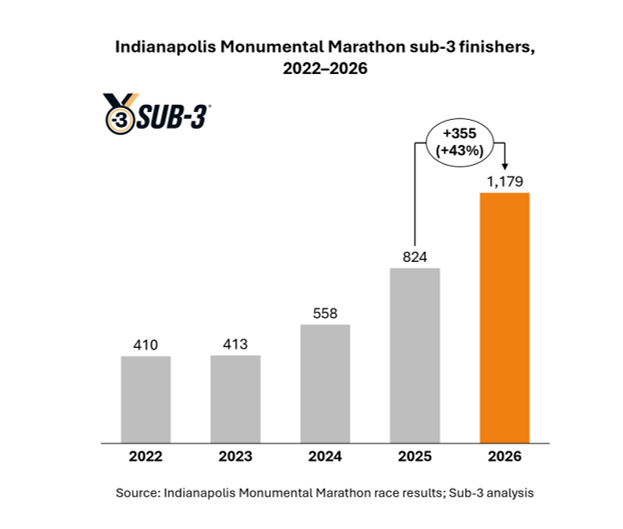
While some of the world's biggest marathons have seen their sub-three-hour percentages decline as participation expands, the Indianapolis Monumental Marathon is heading firmly in the opposite direction. The 2026 race attracted a record 8,437 finishers, with 1,179 breaking three hours, giving it a sub-3 rate of 14.0%, the highest in our five-year analysis.
The performance continues a remarkable period of growth for a race that has quietly established itself as one of America's leading destinations for competitive amateur runners. Since 2022, the total finishing field has increased by 83%, while the number breaking three hours has risen by an extraordinary 188%.
Indianapolis entered this year's race with an already formidable reputation, having placed 10th in Sub-3's 2026 World Marathon Rankings, based on performances recorded during 2025. With new course records, more than 1,000 sub-3 finishers for the first time and another substantial increase in participation, its credentials have only strengthened.
Five years of increasingly fast running
Indianapolis's improvement has been unusually consistent. In 2022, 410 of the race's 4,603 finishers broke three hours, equivalent to 8.9%. That increased to 9.8% in 2023 and 9.9% in 2024, before jumping to 12.3% last year.
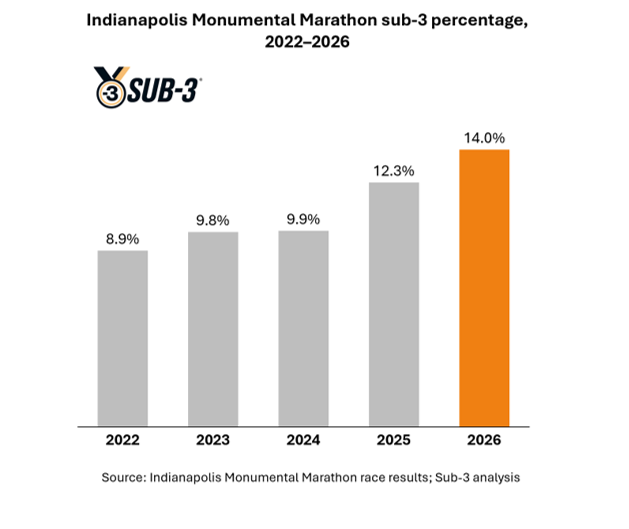
This year's increase to 14.0% continues that progression, with approximately one in every seven finishers achieving the three-hour benchmark. It is an impressive concentration of fast runners for an event that has substantially expanded its appeal over the same period.
The absolute numbers are perhaps even more striking. Indianapolis recorded 824 sub-3 finishers in 2025, itself a substantial increase on the previous year's 558. This year's total of 1,179 represents another 43% increase in a single year, adding 355 runners to an already highly competitive field.
Meanwhile, overall participation continues to surge. Marathon finishers increased from 6,679 last year to 8,437 in 2026, a rise of 26%, following several years of strong growth.
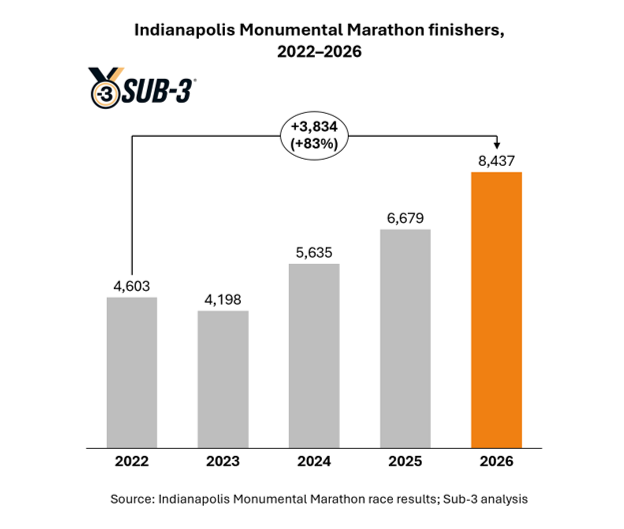
The distinction is important. Indianapolis is not simply adding more runners and seeing its sub-3 percentage diluted as a consequence. The faster end of the field is expanding at an even greater rate, suggesting that the race's growing reputation for competitive amateur running is attracting increasing numbers of athletes with ambitious finishing-time targets.
Two course records and 28 Olympic Trials qualifiers
The elite races provided further evidence of Indianapolis's credentials as a fast marathon.
Indiana's Johnnie Guy won the men's race in an official time of 2:11:47, breaking the course record of 2:12:29 established by Joseph Whelan just twelve months earlier. The 32-year-old finished nearly 90 seconds ahead of Cameron Dickson, who took second in 2:13:16, with Kobe Blanco third in 2:14:12.
The women's race produced an even closer finish. Lindsey Bradley, who previously won Indianapolis in 2024, returned to break her own course record with a time of 2:29:47, improving on her previous best of 2:31:49. Isabel Hebner finished just over a second behind in 2:29:48, while Melissa Berry completed the podium in 2:31:40.
The depth of competitive running extended well beyond the winners. Organisers reported that 28 athletes achieved qualifying standards for the 2028 US Olympic Marathon Trials, more than double the number recorded last year. The wider event also produced new course records in the men's half marathon and women's 5K, completing a particularly successful day for Indianapolis.
How Indianapolis became a destination for fast marathon runners
Indianapolis's growing reputation has been nearly two decades in the making. Founded in 2008 by former city engineer Carlton Ray, who wanted to establish a nationally recognised marathon in his home city, the inaugural event attracted around 1,100 marathon finishers. By 2015 that figure had risen to more than 4,000, and the race has since developed into one of America's 15 largest marathons.
Much of that success rests on a course that combines the atmosphere of a major city event with the opportunity to run a genuinely fast time. Starting and finishing in downtown Indianapolis, the route takes runners past some of the city's most recognisable landmarks, including the Soldiers and Sailors Monument, before winding through historic neighbourhoods and leafy residential streets.
The largely flat terrain and typically cool November conditions have made it particularly popular with runners chasing personal bests and Boston qualifying times. Almost one in five finishers achieved a Boston qualifying standard in 2025, while the increasingly competitive elite field has helped reinforce the event's reputation as a destination for serious distance runners.
Conditions this year were also favourable. Indianapolis enjoyed a cool, largely dry race morning, with temperatures around 5°C at the start and relatively modest winds. Such conditions are well suited to fast marathon running, particularly compared with the warmer weather that has affected several other major races this autumn.
The race has also managed to retain much of its community character despite its rapid expansion. Beyond Monumental, the not-for-profit organisation responsible for the event, has donated more than $1.7 million to youth health and fitness programmes since its foundation, supporting initiatives that encourage children across Indianapolis to become more active.
This year's event marked its 14th consecutive sellout, with places selling out earlier than ever before. Across the marathon, half marathon and 5K, the organisers welcomed participants from all 50 American states and more than 35 countries, underlining just how far the event has come from its relatively modest beginnings.
Already among the world's fastest marathons
Indianapolis's growing reputation was recognised earlier this year when it secured 10th place in Sub-3's World Marathon Rankings, which analysed 286 marathons across 61 countries using results from 2025.
The rankings consider three factors: the proportion of runners breaking three hours, the absolute number of sub-3 performances and the fastest finishing time. Indianapolis performed strongly across all three measures, earning its place alongside some of the world's most established marathons, including Valencia, Boston, Chicago and London.
This year's results represent another significant improvement. With 1,179 sub-3 finishers, Indianapolis has moved into a different category in terms of competitive depth, while the new men's course record strengthens its performance at the front of the field. Its position in the next edition of the rankings will depend on results from other races and the final scoring methodology, but the underlying figures suggest that Indianapolis remains a serious contender among the world's leading marathons for sub-3 runners.
Getting bigger without sacrificing speed
Indianapolis's achievement is particularly noteworthy against the backdrop of rapidly expanding marathon participation worldwide. Recent Sub-3 analyses of Chicago, Melbourne and New York have highlighted how growth in overall finishing numbers does not necessarily translate into a corresponding increase in faster performances.
Indianapolis demonstrates that the two can develop together. Over five editions, the race has attracted thousands of additional participants while nearly tripling its sub-3 population, an impressive achievement for an event that is still considerably smaller than the World Marathon Majors.
There are obvious attractions for competitive runners. The relatively flat course, favourable autumn timing and reputation for Boston qualifying performances provide a compelling combination, while the growing depth of the field increases the likelihood of finding other runners targeting similar times.
Of course, continued expansion will bring challenges of its own. Larger fields place greater demands on start-line organisation, course capacity and runner services, and maintaining the conditions that have made Indianapolis so successful will require careful planning as participation increases further.
But there is much to celebrate about a marathon that is growing in both size and competitive strength. With its 20th edition approaching in 2027, Indianapolis has established itself as far more than a convenient alternative to America's better-known city marathons. For runners looking to combine the atmosphere of a major event with a serious opportunity to run a personal best, it is increasingly difficult to overlook.
Finding this useful? Help keep Sub-3 running — support us with a coffee.