Melbourne Marathon is booming, but its sub-3 performances aren’t keeping up
Eliud Kipchoge set a course record as Melbourne’s field surged to almost 18,000 finishers, but sub-3 runners made up just 5.4% of the field, the lowest proportion in our five-year dataset.
Eliud Kipchoge added another course record to his extraordinary career at the Melbourne Marathon, winning in 2:09:10 and shaving two seconds from the previous best. At 41, the two-time Olympic champion also claimed his first marathon victory in three years.
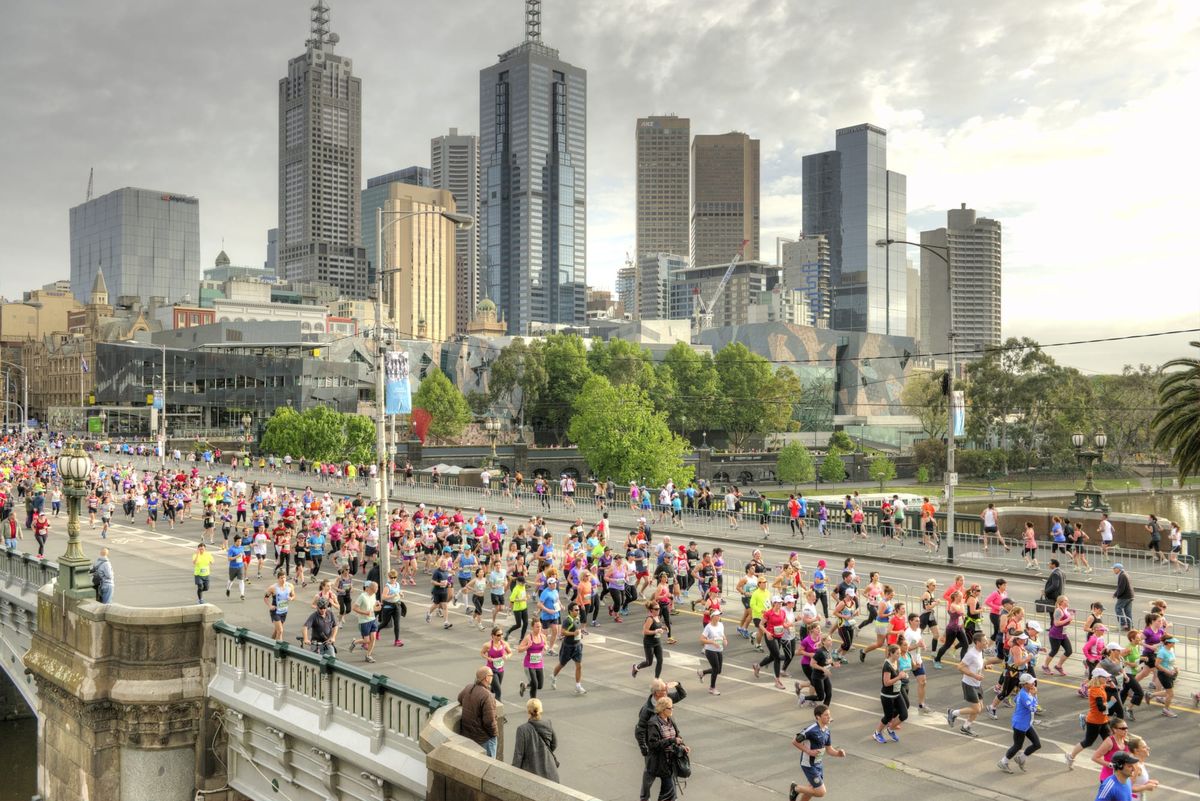
Behind him, Melbourne was undergoing an even bigger transformation. A record 17,731 runners finished the marathon, almost three times the 6,218 recorded at the start of our five-edition analysis in 2022. The number breaking three hours also reached a new high, at 952, but that growth has been substantially outpaced by the expansion of the field as a whole.
Across the five editions from 2022 to 2026, total finishers increased by 11,513, or 185%, while the number of sub-3 runners rose by 490, or 106%. The consequence is that sub-3 runners have become a smaller share of the race, accounting for just 5.4% of finishers this year compared with 7.4% in 2022.
Melbourne’s marathon boom
The scale of Melbourne’s growth is striking. Finishers increased from 6,218 in 2022 to 7,946 in 2023, 8,693 in 2024 and 12,143 last year, before jumping again to 17,731 in 2026.
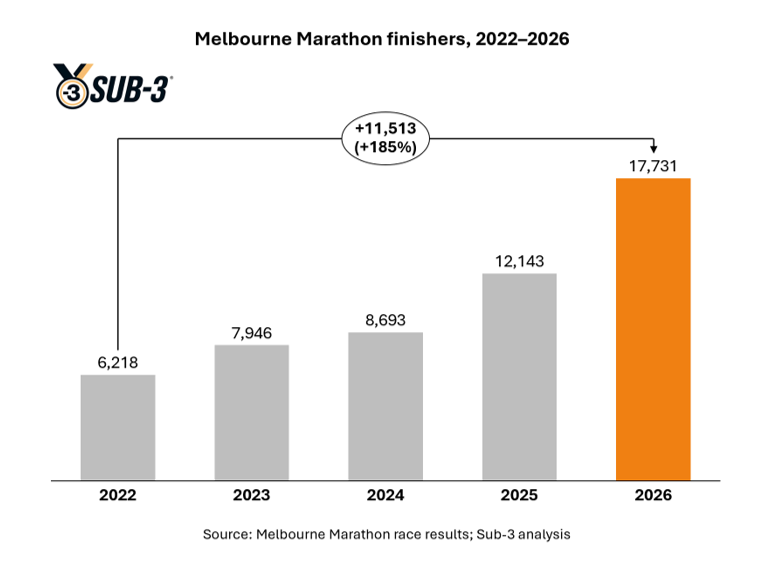
That final jump is particularly significant. Melbourne added another 5,588 finishers in the space of a year, an increase of around 46%, following an already substantial rise in 2025. The race is now operating on a completely different scale from the one represented by the earliest results in our analysis.
That expansion is deliberate. Organisers increased marathon capacity to 20,000 this year as part of a wider transformation of the festival, which now offers 66,000 places across two days. They described the changes as the biggest overhaul of the event in two decades, designed to increase access while improving runner flow and the overall participant experience.
More sub-3 runners, but not at the same rate
The number of runners breaking three hours has risen strongly too. There were 462 sub-3 finishers in 2022, followed by 494 in 2023, 582 in 2024 and 851 last year, before another increase to 952 in 2026.
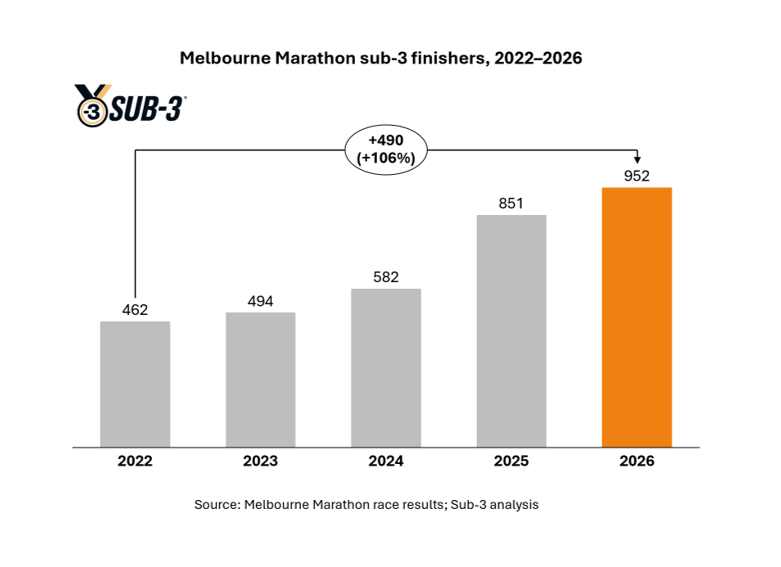
So Melbourne is not becoming short of fast runners. It has added more than 100 sub-3 finishers this year alone, and the size of the sub-three-hour field has more than doubled across the five editions in our analysis.
The difference is simply one of scale. While sub-3 numbers have risen by 106% since 2022, the overall finishing field has grown by 185%, meaning faster runners now make up a smaller proportion of the marathon than they once did.
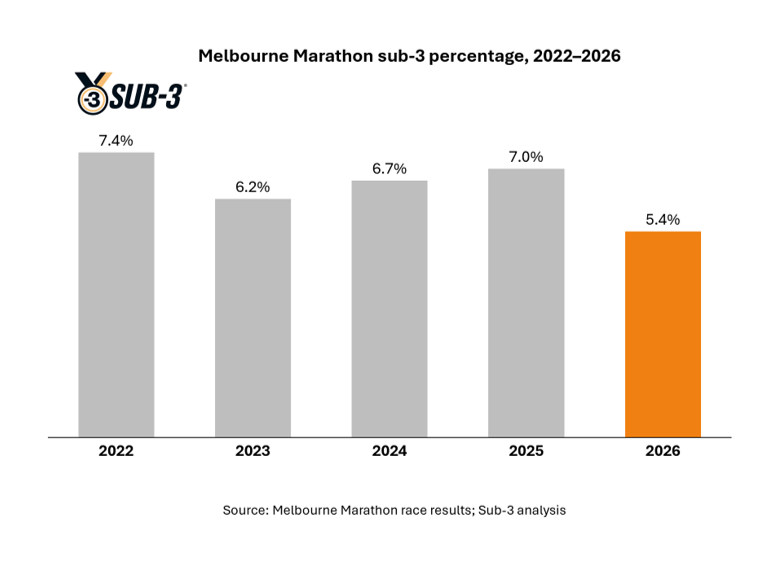
The sub-3 percentage has fluctuated rather than fallen consistently, sitting at 7.4% in 2022, 6.2% in 2023, 6.7% in 2024 and 7.0% last year. But the fall to 5.4% in 2026 is notable, particularly because it comes alongside such a sharp rise in total participation.
A changing field
There has also been a modest shift in the gender balance of the marathon. Women accounted for 23.2% of finishers in 2022 and 27.6% this year, which would be expected to place some downward pressure on the overall sub-3 percentage because a three-hour marathon represents a much higher relative performance standard for women.
That shift is too small to explain much of this year’s fall, however. Women made up 27.7% of finishers in 2025 and 27.6% in 2026, effectively no change at all, while the sub-3 rate dropped from 7.0% to 5.4%.
The broader change therefore appears to be Melbourne’s transition towards a much larger mass-participation race. Its fast-running population is continuing to grow, but the biggest increases are coming elsewhere in the field.
But the weather mattered too
Field composition is not the only factor worth considering. Conditions were also less favourable for fast marathon running than they had been last year, which probably contributed to the particularly sharp fall in the 2026 sub-3 percentage.
Melbourne Olympic Park recorded a minimum temperature of 15.5C on race day, with conditions at 17.1C and 63% humidity by 9am. Temperatures later reached 24.9C, while northerly winds strengthened through the morning and gusted to 48km/h shortly before 11am.
By contrast, race day in 2025 began considerably cooler, with a minimum of 10.2C and a temperature of 13.3C at 9am. The maximum for the day was 20.1C.
For runners around the three-hour mark, that difference is meaningful. The weather does not negate the broader five-edition trend, but it probably exaggerated this year’s drop from 7.0% to 5.4%, making it unwise to attribute the whole change to Melbourne’s evolving participant base.
A faster course should have helped
Interestingly, the redesigned course itself ought to have pushed results in the opposite direction. Organisers said the new marathon route would reduce elevation gain by up to 20%, cut the number of turns and remove the climb from Birdwood Avenue to Domain Road at around 36km.
Kipchoge’s 2:09:10 provided a high-profile demonstration that the course can produce quick running. Thomas Do Canto also ran 2:10:35 for second, while Reece Edwards finished third in 2:14:33.
The course therefore does not provide an obvious explanation for the lower sub-3 percentage. If anything, a flatter and smoother route should have helped, leaving warmer conditions and the rapidly changing composition of the field as the more plausible factors.
Bigger rather than slower
Looking only at Melbourne’s sub-3 percentage could create the impression that the marathon is becoming slower. Looking only at the absolute number of sub-3 runners could produce the opposite conclusion, because there are now more than twice as many as there were in 2022.
The more useful interpretation is that Melbourne’s fast-running population is growing strongly, but the size of the marathon itself is growing much faster. Across five editions, sub-3 performances have increased by 106%, while the finishing field has expanded by 185%, and this year’s warmer conditions appear to have widened that gap further.
Kipchoge’s course record therefore provides an interesting counterpoint to what is happening behind him. Melbourne has become faster at the very front while simultaneously evolving into a much larger mass-participation marathon, and its sub-3 runners are no longer keeping pace with that extraordinary growth.
That demand should be welcomed. It is a sign of the strength of recreational running that so many more people want to take on the marathon, and Melbourne deserves credit for creating space for them. But, as we have seen at other rapidly expanding races, growth on this scale can bring its own problems, from congestion and increased weaving to greater pressure on course services and even hydration supplies. The challenge for organisers is therefore not whether to keep growing, but how to ensure that the infrastructure, wave management and on-course support grow with the field.
Finding this useful? Help keep Sub-3 running — support us with a coffee.