Chicago Marathon 2026: sub-3 numbers tumble despite extraordinary elite race
Amos Kipruto ran 2:01:09 and the women’s race made history, but only 3,353 of Chicago’s 54,592 finishers broke three hours. Sub-3 analysis of five years of results shows just how differently the same marathon can look at the elite and amateur ends.

The Chicago Marathon produced some extraordinary performances on Sunday. Kenya’s Amos Kipruto won the men’s race in 2:01:09, the second-fastest marathon ever run on US soil, while Ethiopia’s Hawi Feysa defended her women’s title in 2:13:33. Feysa was followed by Sharon Lokedi in 2:14:07 and Brigid Kosgei in 2:14:55, making Chicago the first marathon in history to have three women finish inside 2:15.
Further down the field, however, Chicago 2026 was considerably less fast. A total of 3,353 runners broke three hours, down from 4,069 last year, a fall of almost 18 per cent. The proportion of finishers running sub-3 dropped from 7.5 per cent to 6.1 per cent, despite the overall field remaining almost unchanged.
Over 700 fewer sub-3 runners
Last year was a remarkable one for Chicago’s faster amateur field. Some 4,069 runners broke three hours, the highest total in our five-year dataset, with 7.5 per cent of all finishers going under the benchmark.
This year that number fell by 716 to 3,353. The drop cannot be explained by a smaller race: Chicago recorded 54,592 finishers in 2026, compared with 54,328 last year. The finishing field actually grew by 264 runners, or around 0.5 per cent.
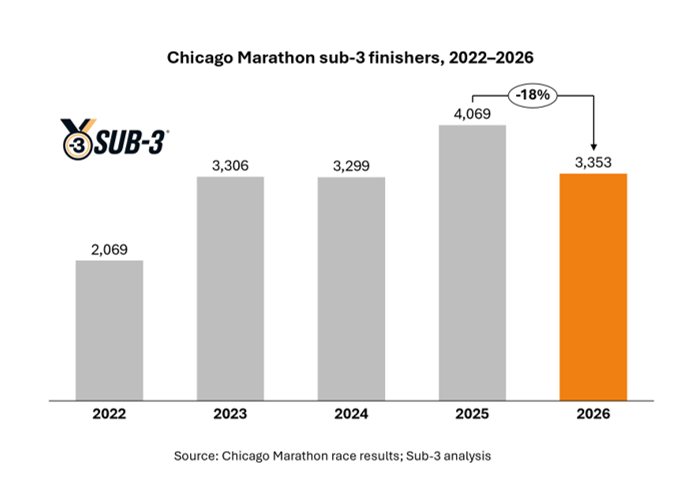
The percentage figure makes the change clearer still. The sub-3 rate fell from 7.5 per cent to 6.1 per cent, below both 2023, when 6.8 per cent broke three hours, and 2024, when the figure was 6.3 per cent.
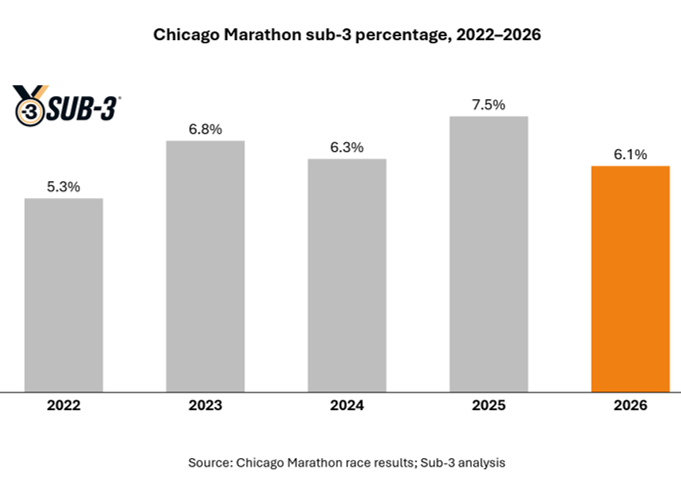
Chicago still produced slightly more sub-3 performances than in 2024, 3,353 compared with 3,299. But there were around 2,500 more finishers this year, so the concentration of sub-three-hour runners was lower.
Almost exactly the same-sized race
The stability of the field makes the comparison with last year particularly useful. Marathon participation figures can make raw sub-3 totals misleading: a race can add thousands of runners and produce more fast performances without becoming faster in percentage terms.
That is not what happened here. Chicago staged almost exactly the same-sized race in 2025 and 2026, yet the number breaking three hours fell by nearly a fifth.
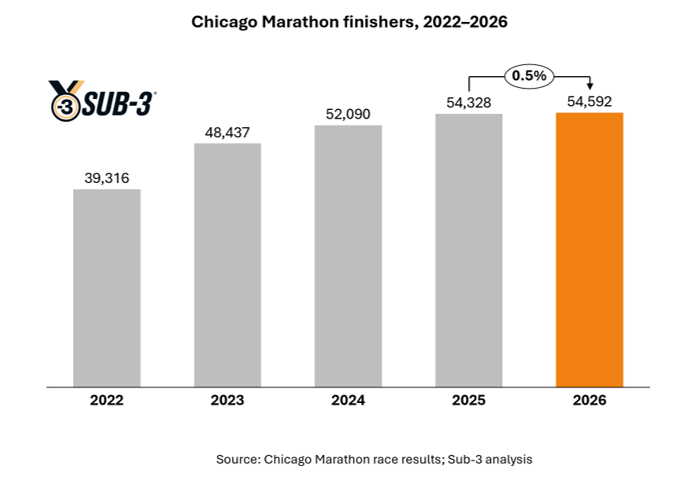
Across the full five-year period, Chicago has still grown substantially. There were 39,316 finishers in 2022, meaning the field has expanded by almost 39 per cent, while the number of sub-3 finishers has risen from 2,069 to 3,353. But 2026 has interrupted what had looked like a fairly clear upward trend in the proportion of faster runners.
Warm weather returns to Chicago
The obvious factor is the weather. Organisers issued a yellow alert ahead of the race as forecasts pointed towards unusually warm conditions, with temperatures expected to rise into the mid-70s Fahrenheit, around 24°C, later in the morning. Runners were advised to adjust expectations, while additional cooling measures were put in place.
The professional field started at 7.30am, followed shortly afterwards by the fastest mass-participation runners, with later waves starting from 8am onwards. That timing matters. Kipruto was finished shortly after 9.30am, while a runner aiming simply to break three hours would remain on the course for almost another hour, with much of the field exposed to rising temperatures for considerably longer.
Weather cannot explain every year-on-year fluctuation in marathon results. The composition of the field changes and individual performances are affected by a host of factors. But a fall of almost 18 per cent in sub-3 finishes from an almost identical-sized field, on a day organisers had already flagged as unusually warm, is difficult to overlook.
An extraordinary elite race
What makes Chicago 2026 particularly interesting is how different the picture was at the very front. Kipruto’s 2:01:09 was a 30-second personal best and moved him to equal fifth on the world all-time list. Only the late Kelvin Kiptum’s remarkable 2:00:35 course record from 2023 has been faster on American soil.
The women’s performances were arguably even more outstanding. Feysa improved her personal best to 2:13:33, while Lokedi and Kosgei joined her below 2:15, the first time three women have broken that barrier in the same marathon. There were strong American performances too. Clayton Young ran 2:05:23, Galen Rupp finished in 2:06:54 at the age of 40, and Emma Grace Hurley ran 2:20:47 on her marathon debut.
Taken on their own, those performances suggest an exceptionally fast day. The wider results tell a different story.
The fastest winner does not necessarily mean the fastest race
Chicago provides another good example of why elite winning times and mass-participation performance should not be treated as interchangeable measures of how fast a marathon was.
In 2023, Kelvin Kiptum ran his world record of 2:00:35, yet 6.8 per cent of finishers broke three hours. Two years later the winning time was a slower 2:02:23, but the sub-3 rate reached 7.5 per cent.
The contrast is sharper again this year. Kipruto ran 1 minute 14 seconds faster than the 2025 winner, yet the proportion breaking three hours fell from 7.5 to 6.1 per cent. The second-fastest winning performance in our five-year dataset therefore coincided with its second-lowest sub-3 rate.
We saw something similar at Berlin in 2025. Sebastian Sawe ran 2:02:16 in difficult heat, yet only 5.0 per cent of the wider field broke three hours. When cooler conditions returned this year, the winning time was slower but the sub-3 rate rebounded to 7.5 per cent.
So, was Chicago slow in 2026?
Chicago remains one of the world’s fastest major marathons, and 3,353 sub-three-hour finishers is still an enormous number. But the 2026 results suggest that Sunday was significantly less favourable for the wider field than last year.
With virtually the same number of finishers, 716 fewer runners broke three hours and the sub-3 rate fell from 7.5 to 6.1 per cent. Yet at the front Kipruto ran 2:01:09 and three women broke 2:15 for the first time.
That is perhaps one of the most intersting findings from Chicago 2026. A marathon can produce extraordinary performances at the front while proving considerably tougher for the thousands of fast amateur runners behind them.
Finding this useful? Help keep Sub-3 running — support us with a coffee.