Berlin Marathon 2026: sub-3 numbers bounce back after last year’s heat
More than 3,700 runners broke three hours in Berlin on Sunday, a 55 per cent increase in a year. Five years of results show just how much conditions can shape marathon times.
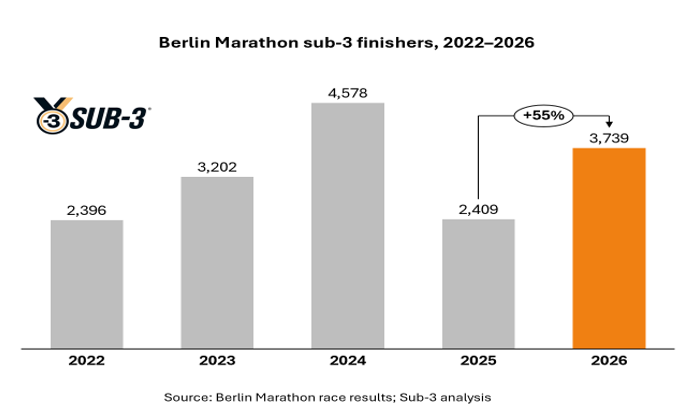
The Berlin Marathon was fast again on Sunday. A total of 3,739 runners broke three hours, up from just 2,409 last year, an increase of 55 per cent in the space of 12 months.
That wasn't simply because there were more runners. The number of finishers increased by only around three per cent, from 48,361 to 50,020, while the proportion of the field breaking three hours jumped from 5.0 per cent to 7.5 per cent. After the unusually hot conditions that battered runners in 2025, this year's much kinder weather seems to have made a substantial difference.
Last year's race took place in temperatures that climbed into the mid-20s, making life increasingly difficult for runners as the morning went on. This year, organisers had forecast around 13°C at the start and 17.5°C by the time the elite runners finished, and subsequently described the conditions as "good". For the thousands of club runners trying to squeeze every second out of Berlin's famously fast course, the difference between the two years was significant.
Past five years
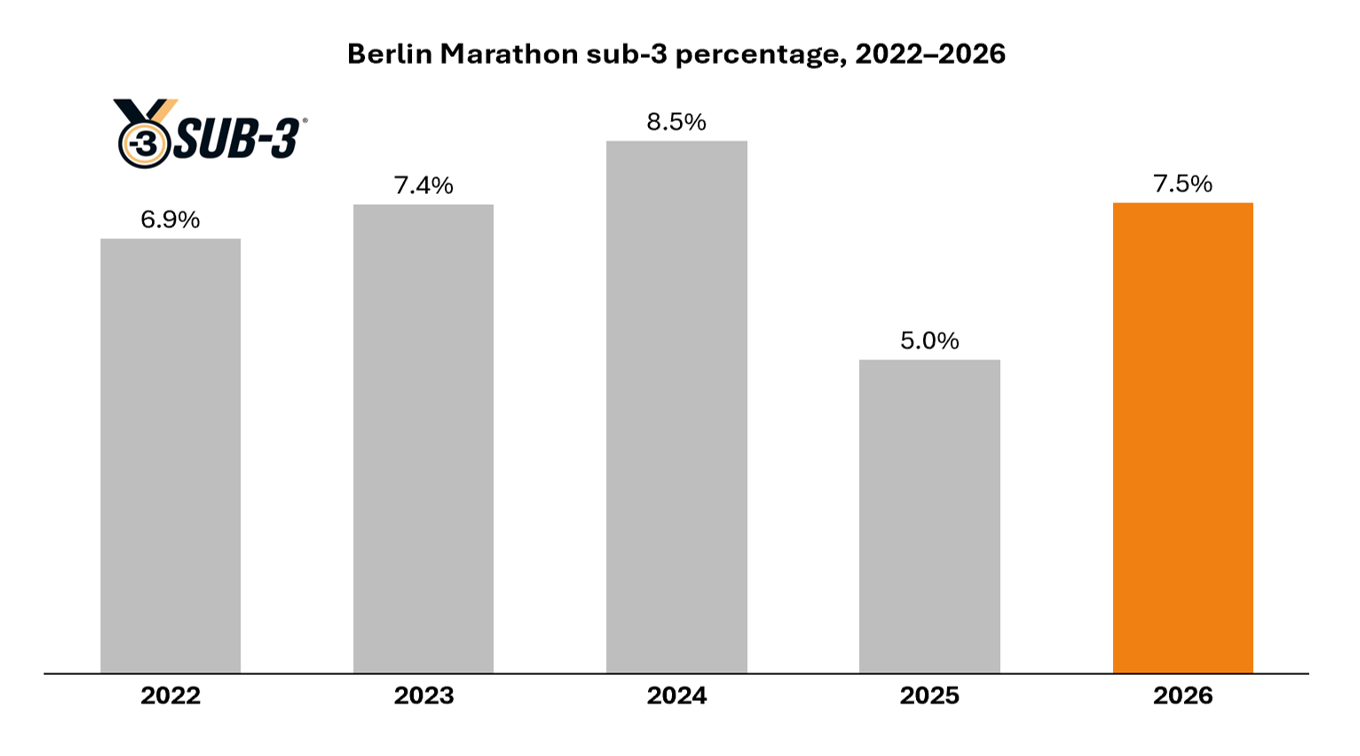
Seen across five years, 2025 increasingly looks like an outlier. Berlin's sub-3 rate rose from 6.9 per cent in 2022 to 7.4 per cent in 2023 and 8.5 per cent in 2024, before plunging to 5.0 per cent in last year's heat. Sunday's 7.5 per cent puts Berlin almost exactly back at its 2023 level.
The longer-term numbers are perhaps more interesting. Berlin has grown enormously, from 34,752 finishers in 2022 to 50,020 this year, an increase of around 44 per cent. Over the same period, the number of sub-3 finishers has risen from 2,396 to 3,739, an increase of 56 per cent. Much of the increase in absolute sub-3 numbers is obviously explained by Berlin becoming a bigger race, but the faster end of the field has grown slightly more quickly than the field as a whole.
The standout year remains 2024. Some 4,578 runners broke three hours, representing 8.5 per cent of all finishers, comfortably the highest number and proportion in our five-year dataset. This year's figures are therefore a strong rebound rather than a new high.
What a difference a year makes
The contrast between 2025 and 2026 is particularly revealing. Last September, Berlin was hit by distinctly unfriendly marathon weather, with temperatures reaching the mid-20s during the race and much of the course exposed to the sun. Yet Kenyan star Sabastian Sawe somehow produced an extraordinary 2:02:16, the fastest marathon in the world that year.
For the rest of the field, the story was rather different. Only 2,409 runners broke three hours, compared with 4,578 the previous year, while the sub-3 rate fell from 8.5 per cent to just 5.0 per cent. It was by some distance the weakest showing in our five-year dataset.
This year, with much more favourable conditions, an additional 1,330 runners broke three hours, despite there being only 1,659 more finishers overall. Put another way, roughly one in 20 finishers broke three hours last year, compared with around one in 13 on Sunday.
Berlin's organisers had also made changes after the problems of 2025, bringing the mass start forward by 30 minutes and adding additional cooling stations. The more favourable weather meant those measures were not tested to anything like the same extent, but the contrast in results is a useful demonstration of just how dramatically conditions can affect a marathon field.
The fastest winner doesn't necessarily mean the fastest race
There is a curious disconnect between Berlin's elite winning times and the results further down the field. Guye Adola won Sunday's men's race in 2:02:50, a personal best and his second Berlin victory, finishing ahead of Gemechu Dida in 2:03:19 and Gabriel Geay in 2:03:59.
By Berlin's extraordinary standards, however, 2:02:50 isn't especially quick. Eliud Kipchoge won in 2:01:09 in 2022, while the winning times were 2:02:42 in 2023, 2:03:17 in 2024 and 2:02:16 in 2025. Adola's performance was therefore only the fourth-fastest winning time of the past five editions.
The comparison with last year is particularly striking. Sawe ran 34 seconds faster in the heat of 2025 than Adola did in Sunday's better conditions, yet the proportion of ordinary runners breaking three hours was dramatically lower. Sawe had been due to defend his title this year but withdrew around a month before the race because of injury.
Go back another year and the relationship is reversed. The slowest men's winning time in our five-year dataset, 2:03:17 in 2024, coincided with the highest sub-3 percentage, at 8.5 per cent. Last year's second-fastest winning time coincided with easily the lowest.
That helps explain why winning time accounts for only a relatively small part of our annual Sub-3 World Marathon Rankings. An elite winner's performance can be extraordinary even when conditions are difficult, while the results of several thousand club runners give us a much broader picture of how fast a particular edition of a marathon really was.
Assefa comes close to something extraordinary
If the men's winning time was relatively unspectacular by Berlin standards, the women's race was anything but. Tigst Assefa returned to the course where she had previously broken the world record and set off at a pace that put the current mark under serious threat.
The Ethiopian passed halfway in 1:04:57 and 30km in 1:32:19. With five kilometres remaining she was still on course for a finish of around 2:09:36, which would have broken Ruth Chepngetich's world record of 2:09:56. But at around 40km, Assefa developed a problem with her right leg and her stride deteriorated badly over the closing stages.
Remarkably, she still finished in 2:11:04, breaking her own Berlin course record and recording the third-fastest women's marathon ever run. Combined with Adola's 2:02:50, Berlin's two winners recorded an aggregate 4:13:54, which organisers say is the second-fastest combined men's and women's winning time in marathon history.
It also reinforces the wider point. Elite performances tell us something important about a marathon, but they don't necessarily tell us what sort of day the other 50,000 runners experienced.
So, is Berlin getting faster?
Over five years, the answer isn't quite as straightforward as it might seem. There is an underlying upward trend: Berlin has grown from fewer than 35,000 finishers in 2022 to just over 50,000 this year, while its population of sub-3 runners has grown slightly faster.
But the annual sub-3 percentages have been anything but smooth: 6.9, 7.4, 8.5, 5.0 and 7.5 per cent. The extraordinary swing between 2024 and 2025, followed by this year's rebound, shows the danger of treating marathon results as though they were produced in identical conditions.
Course profile matters, as do field strength, shoe technology and the general improvement in elite amateur running. Over 26.2 miles, though, weather can overwhelm all of them. Last year's Berlin field contained thousands of the same sort of fast, well-trained runners who lined up again on Sunday, but far fewer of them were able to translate that fitness into a sub-three-hour finish.
Berlin remains one of the great destinations for runners chasing fast marathon times, and Sunday's 3,739 sub-3 performances provide plenty more evidence for that reputation. But perhaps the most revealing statistic from Berlin 2026 is that almost exactly the same race produced just 2,409 sub-3 finishes a year earlier. Sometimes the difference between a fast marathon and a difficult one really can be as simple as the weather.
Finding this useful? Help keep Sub-3 running — support us with a coffee.