Abingdon Marathon 2026: why this small-town classic remains a sub-3 powerhouse
With 14.7% of finishers breaking three hours, Abingdon has recorded Britain's highest sub-3 percentage of 2026 so far, continuing a remarkable tradition stretching back more than four decades.
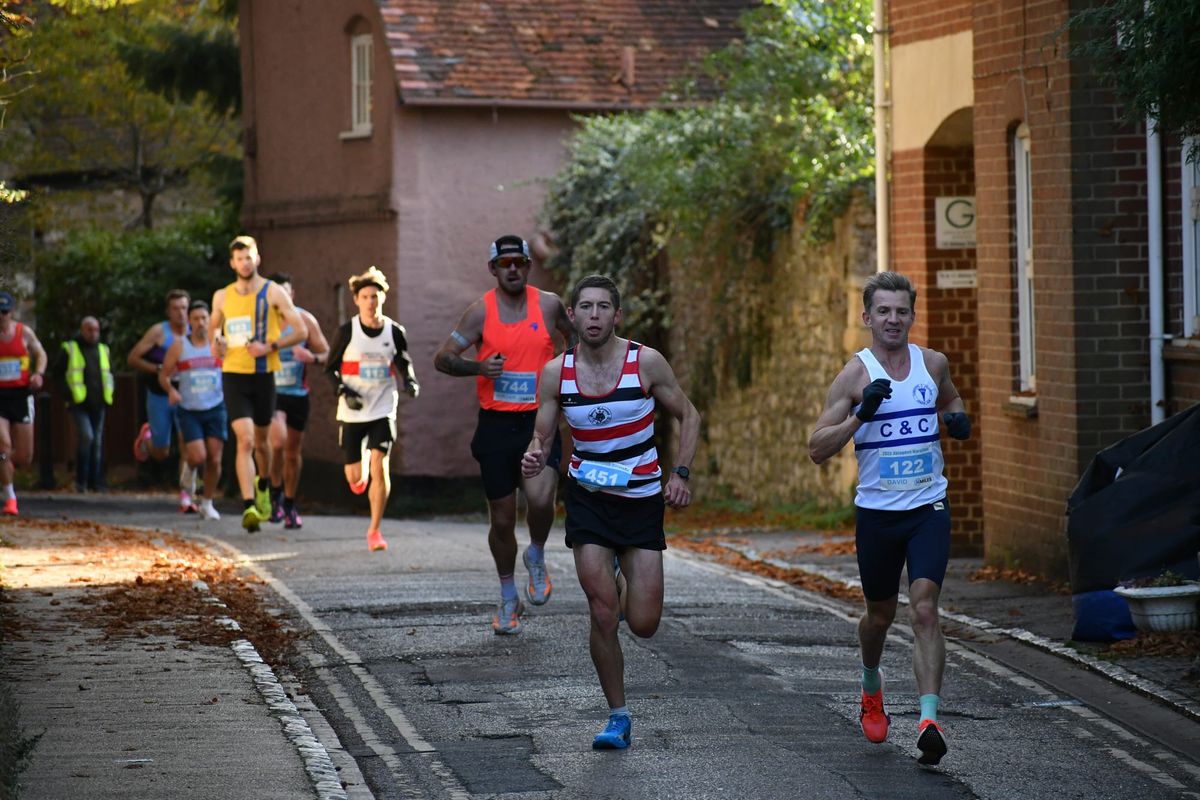
While the world's biggest marathons compete to attract tens of thousands of runners, an altogether smaller race in the leafy Oxfordshire countryside continues to produce some of Britain's most impressive sub-three-hour statistics. The Abingdon Marathon welcomed 1,023 finishers on Sunday, 18 October, with 150 breaking three hours, giving it a remarkable sub-3 rate of 14.7%.
That is the highest percentage we have recorded at any qualifying UK marathon in 2026 so far, considerably ahead of Newport and Chester, which finished second and third in our 2025 UK analysis of sub-3 percentages. Those races recorded sub-3 percentages of 9.8% and 4.9% respectively at their 2026 editions. Perhaps most impressively, Abingdon achieved this year's result without the England–Wales Masters international that helped boost its sub-3 figures in 2025.
A remarkable concentration of fast runners
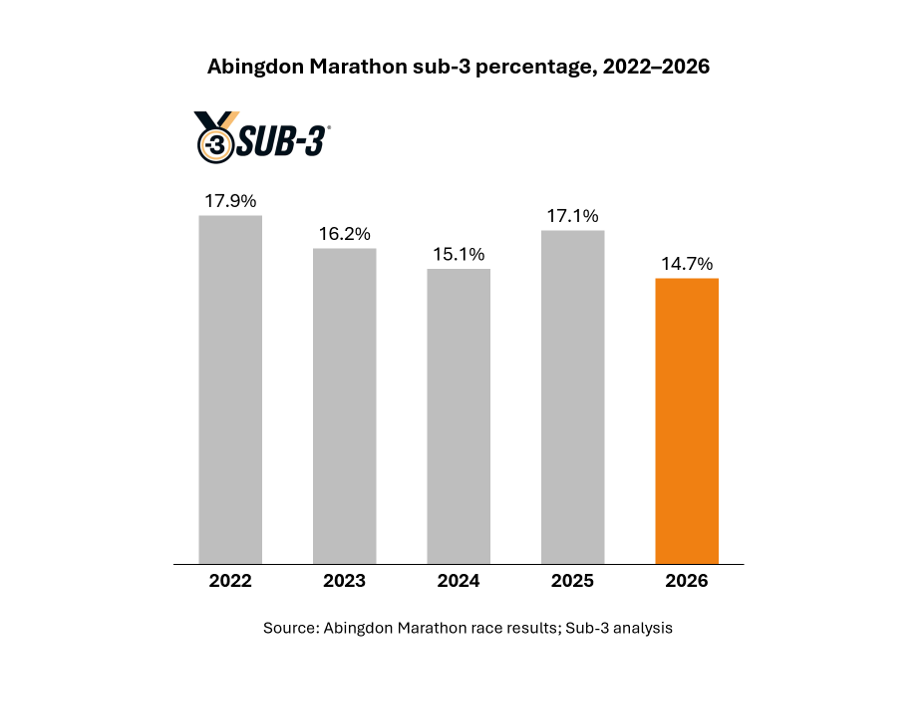
Abingdon's reputation for fast amateur running is nothing new. Across the five editions from 2022 to 2026, the proportion breaking three hours has remained consistently high, ranging from 17.9% in 2022 to 14.7% this October. Even at its lowest point in our analysis, approximately one in every seven finishers has managed to break the three-hour barrier.
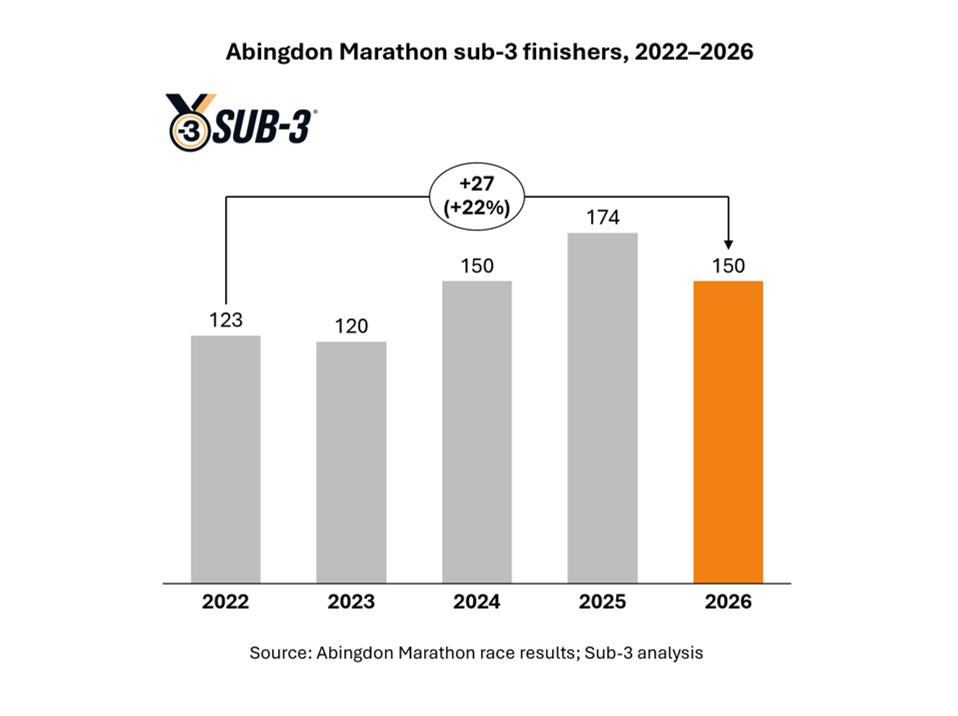
The absolute numbers tell a similarly encouraging story. There were 123 sub-3 finishers in 2022, followed by 120 in 2023, 150 in 2024 and a five-year high of 174 last year, before returning to 150 in 2026. That consistency is particularly impressive for an event whose field is just over a thousand, rather than tens of thousands.
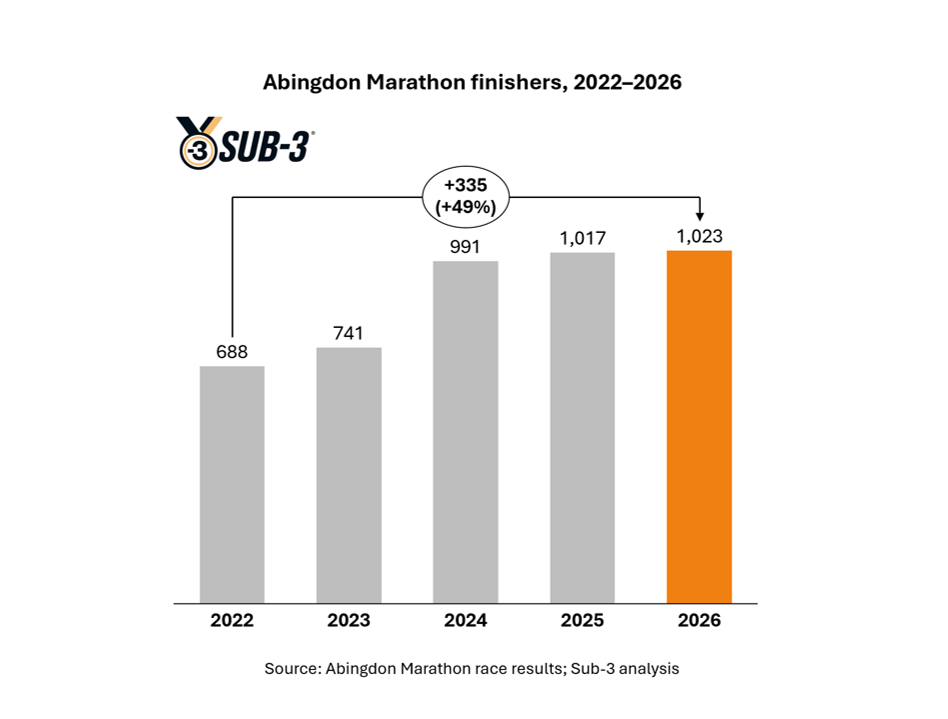
The overall marathon has also grown, from 688 finishers in 2022 to 1,023 this year, an increase of 49%. Much of that expansion occurred between 2023 and 2024, with participation remaining relatively stable over the past two editions. Abingdon has consequently managed to attract more runners while retaining the strongly competitive character that makes it distinctive.
The impact of the Masters international
Last year's particularly strong showing was almost certainly helped by Abingdon hosting the England–Wales Masters representative marathon. The competition attracted leading runners from across the age groups and produced an absorbing battle for the overall victory, with England's Tom Hollis and Jonathon Frost catching Welsh M40 athlete James Elgar in the closing kilometres. Hollis eventually took the win, while Wales's Louise Flynn claimed the women's title in 2:46:41.
The England Masters international took place at Manchester in April 2026, removing one obvious reason for Abingdon's exceptional results last year. Yet with the finishing field virtually unchanged, the number of sub-3 runners fell by only 24. The championship evidently attracted additional competitive runners, but Abingdon's latest figures demonstrate that its appeal to the faster end of the field extends well beyond representative competitions.
From the People's Marathon to a British institution
Abingdon's credentials stretch back considerably further than our five-year dataset. The race was conceived in 1981, when organiser Larry Blackwell suggested, initially in jest, that the town could stage its own answer to the recently established London Marathon. The first Abingdon People's Marathon took place on 3 May 1982, organised by Radley Ladies Athletic Club and Abingdon Lions Club, attracting almost 1,800 entrants.
One particularly welcome feature of Abingdon is that the organisers have preserved the race's results history, with an extensive archive stretching back to the inaugural event available through their website. It is a treasure trove for anyone interested in the evolution of British amateur marathon running, offering a window into the sport long before carbon-plated shoes, GPS watches and today's enormous city marathons.
Looking back through those records reveals how deeply rooted Abingdon's competitive tradition is. In 1986, 89 of the race's 769 finishers broke three hours, equivalent to 11.6%, while the corresponding figures were 12.9% in 1996, 8.5% in 2006 and 11.1% in 2016. The fact that this year's percentage exceeds each of those snapshots suggests that Abingdon's reputation for attracting serious amateur runners is as strong as ever.
Originally held in spring, the race eventually moved to October, establishing itself as a fixture in the British autumn marathon calendar. Its enduring appeal lies in an approach that has changed relatively little: a friendly, volunteer-organised event, run on a not-for-profit basis, with an emphasis on the runners themselves. The marathon raised £20,300 for local charities and organisations in 2025, continuing a charitable tradition that dates back to its foundation.
The organisers are also making a concerted effort to encourage more female runners, partnering with SheRaces and extending the race cut-off from five to six hours to make the marathon more accessible. That commitment extends to practical measures, including additional toilets, period and incontinence products at aid stations, private breastfeeding facilities and a generous pregnancy and adoption refund policy.
An appealing alternative to the big city marathon
For runners chasing a personal best, Abingdon offers something increasingly difficult to find at the biggest city marathons: a relatively small field containing an unusually high proportion of runners with similar ambitions. There is something rather appealing about swapping the skyscrapers, crowds and logistical challenges of London or Manchester for a traditional market town and the surrounding Oxfordshire countryside.
The flat course starts and finishes on the athletics track at Tilsley Park, taking runners through Abingdon's historic town centre before heading into the surrounding countryside. The route passes through the picturesque villages of Drayton, Milton and Sutton Courtenay, with traditional village streets and leafy country roads providing an altogether different backdrop from the major city events. The 2026 edition featured a revised route, while retaining the character of the race and its distinctive stadium finish.
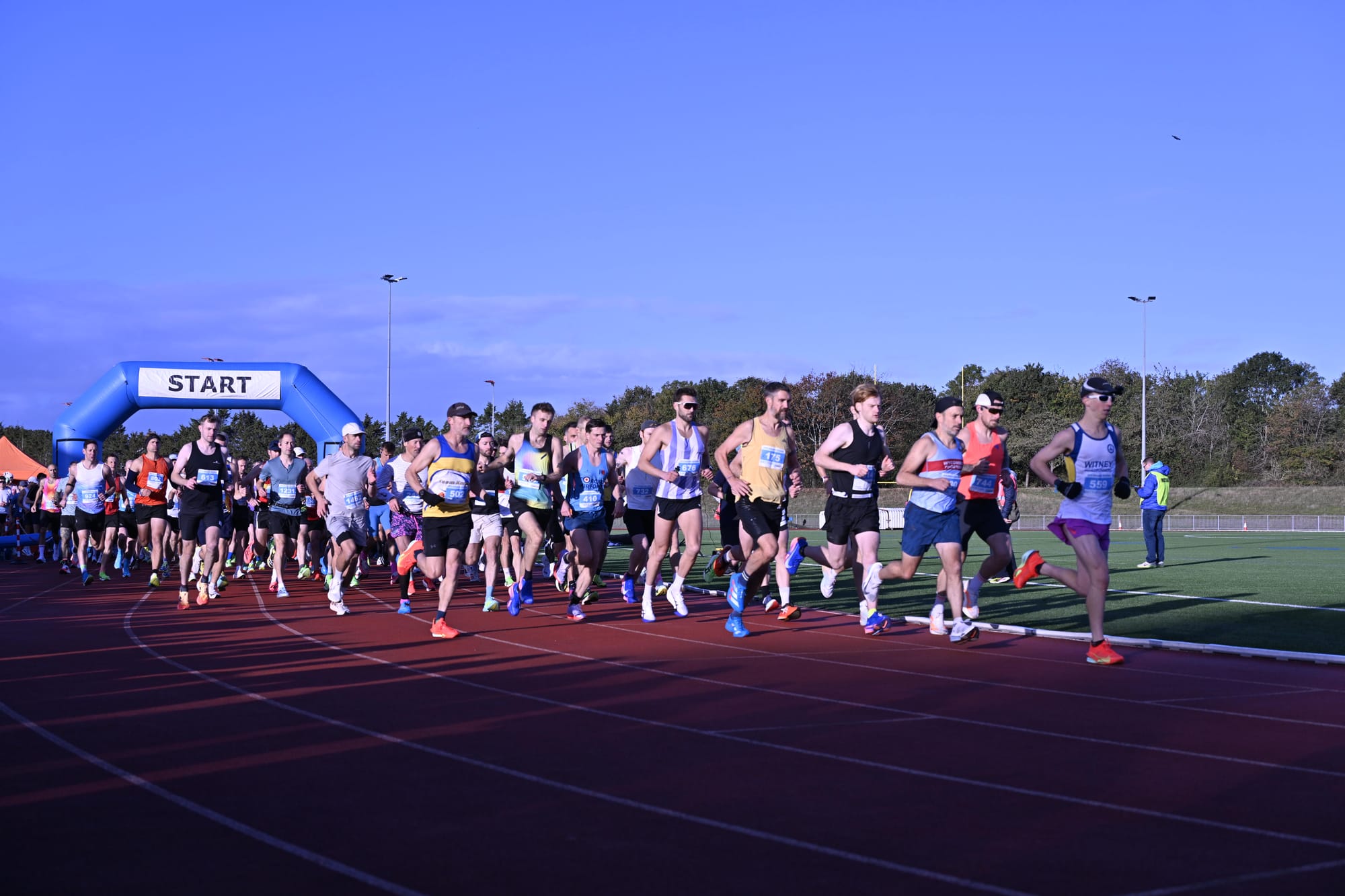
That smaller scale can be particularly appealing to runners frustrated by congestion and weaving around slower participants, although Abingdon has its own considerations, including narrow sections and roads that remain open to traffic. The prospect of running alongside plenty of similarly paced club runners is another attraction, with more than 300 UK clubs represented at the 2025 event. For those seeking a fast autumn marathon without the overwhelming scale of a major city race, it offers a compelling alternative.
Abingdon's place in the UK rankings
Abingdon topped the Sub-3 UK rankings published earlier this year, based on its outstanding 2025 performance. Those rankings consider not only the proportion of runners breaking three hours, but also the absolute number of sub-3 finishers and the winning time, allowing races of very different sizes to be compared.
On that broader measure, London poses a formidable challenge in 2026. The capital's marathon produced 3,306 sub-3 finishers, compared with Abingdon's 150, although they represented just 5.5% of London's much larger field. Sabastian Sawe's extraordinary 1:59:30 world record also gives London an enormous advantage on winning time.
However, with the 2026 UK marathon calendar drawing towards its conclusion, Abingdon nevertheless looks well placed to retain its position as Britain's leading marathon by sub-3 percentage.
At a time when marathon running is enjoying extraordinary growth, there is much to celebrate about the success of the major city races and their ability to introduce thousands of new runners to the distance. But larger fields can also mean congested starts and crowded sections of the course, forcing runners to weave around others rather than follow the shortest racing line. That extra distance can cost valuable time for anyone chasing a personal best, making smaller, competitively minded events such as Abingdon particularly appealing.
Abingdon is a reminder that there is still an important place for the traditional club-focused marathon, where the emphasis is on good organisation, a fast course and the running itself. More than four decades after its founding, this small Oxfordshire race continues to punch well above its weight, and for runners targeting that elusive sub-three-hour finish, it deserves to be near the top of the list.
Finding this useful? Help keep Sub-3 running — support us with a coffee.