New York City Marathon 2026: a record field and a sub-3 puzzle
Andreas Almgren made a remarkable marathon debut as New York celebrated 50 years of its five-borough course. But despite record participation, sub-3 performances fell sharply, raising questions about the changing composition of the field.
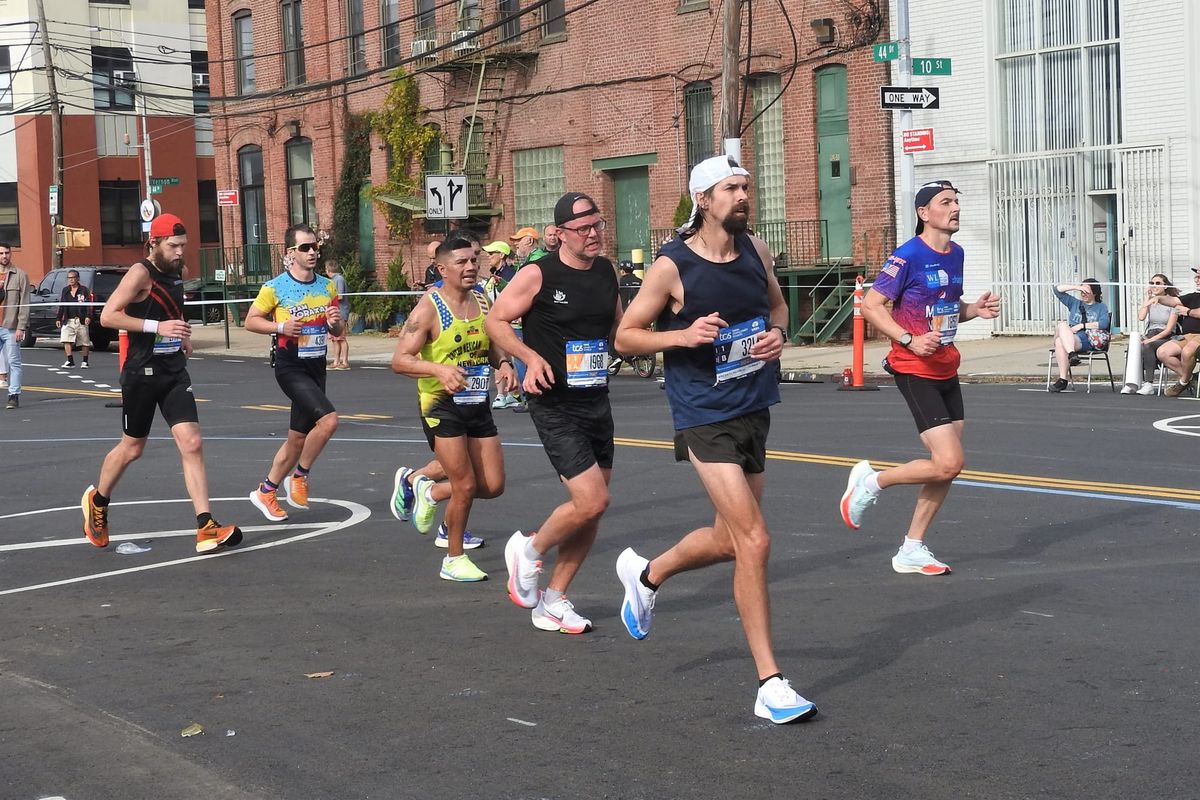
The New York City Marathon celebrated the 50th anniversary of its iconic five-borough course in spectacular fashion on Sunday. Sweden's Andreas Almgren won on his marathon debut in 2:06:01, the third-fastest time in the event's history, while Kenya's Sheila Chepkirui reclaimed the women's title in 2:24:36. With an estimated 61,062 finishers crossing the line in Central Park, it was another extraordinary demonstration of the enduring appeal of the world's largest marathon.
Further down the field, however, the results tell a rather different story. Sub-3 analysis of the race found that 1,747 runners broke three hours, compared with 2,394 last year, a fall of 647 runners or 27%. The proportion of finishers achieving the benchmark dropped from 4.0% to 2.9%, reversing three consecutive years of improvement and raising an interesting question about why New York's faster amateur field appears to have contracted.
Three years of progress interrupted
The five-year figures reveal a striking pattern. In 2022, just 681 of New York's 47,745 finishers broke three hours, equivalent to 1.4% of the field. That rose to 1,375 in 2023 and 2,185 in 2024, before reaching a five-year high of 2,394 last November.
The improvement was particularly impressive because it considerably outpaced the growth in overall participation. Between 2022 and 2025, the number of sub-3 runners more than tripled, while the overall field grew by less than a quarter. Some of that improvement reflected more favourable racing conditions, particularly after the unusually hot 2022 edition, but New York also appeared to be attracting an increasingly strong competitive amateur field.
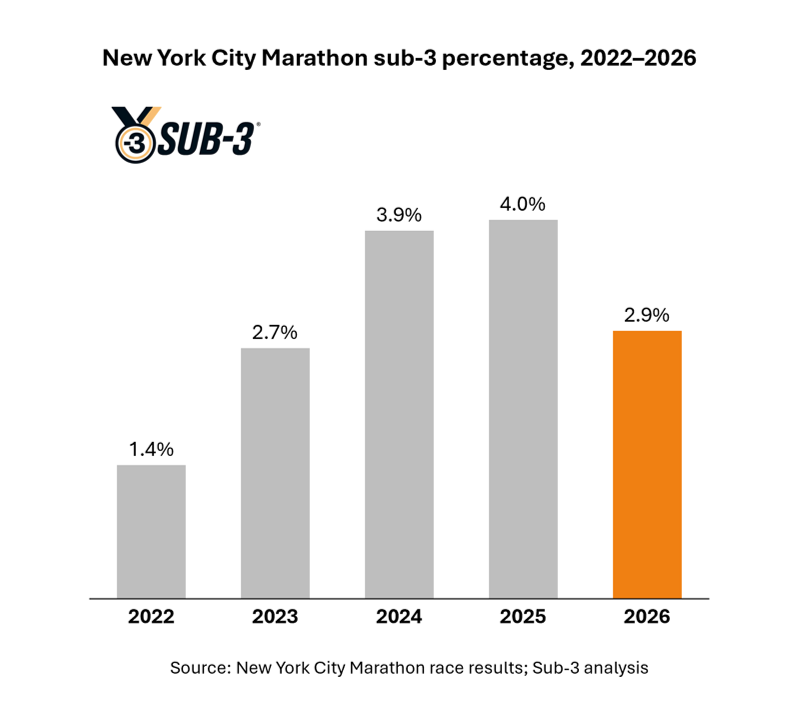
That trend came to an abrupt halt in 2026. The number breaking three hours fell below even the 2024 figure, despite the marathon attracting more than 5,500 additional finishers compared with two years ago. This was not simply a case of slower runners joining the event and reducing the overall percentage: there were substantially fewer sub-3 performances in absolute terms too.
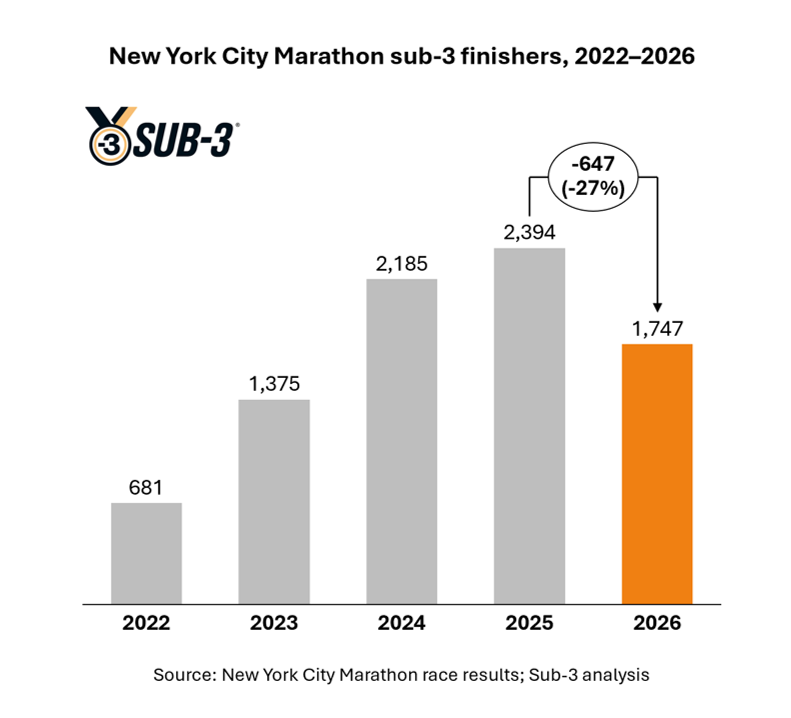
Nevertheless, the longer-term picture remains encouraging. Even after this year's decline, New York's sub-3 percentage is more than double its 2022 level, while the absolute number breaking three hours is around two and a half times higher. The question is whether 2026 represents a temporary interruption or the beginning of a more sustained change.
New York's extraordinary participation boom
While the faster end of the field contracted, the marathon itself continued its remarkable expansion. Our analysis records 61,062 finishers in 2026, compared with 59,122 last year, an increase of approximately 3.3%. Across the five editions from 2022 to 2026, the field has grown by almost 28%, adding more than 13,000 finishers.
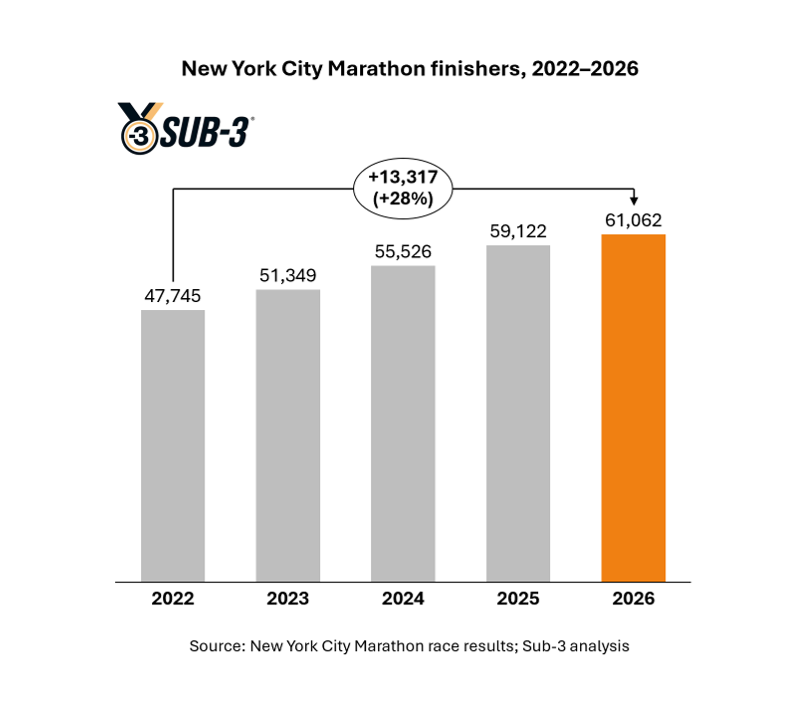
Demand for places has become extraordinary. New York Road Runners (NYRR) received more than 240,000 applications for the 2026 general ballot, almost 20% more than the previous year, with only around 1% of applicants successful. The vast majority of runners therefore secured their places through other routes, including time qualification, charity fundraising, international tour operators and NYRR's local 9+1 programme, which rewards participation in nine qualifying races and volunteering at another.
The scale of that demand reflects something worth celebrating. New York has evolved into one of the world's great mass-participation sporting occasions, attracting runners of widely differing abilities and ambitions. But as the event expands, maintaining a strong competitive amateur presence alongside its broader participant base presents an interesting challenge.
Was the weather responsible?
Weather provides an important part of the explanation for New York's historical results, particularly the exceptionally low sub-3 percentage recorded in 2022. That year's marathon took place in unusually warm conditions, with temperatures climbing towards 24°C, making sustained fast running considerably more difficult.
The subsequent editions benefited from cooler weather. In 2024, temperatures were around 5°C at the start, while last year's race also began in the single figures. Both produced considerably stronger sub-3 percentages, reaching 3.9% and 4.0% respectively.
This year was somewhat milder than those particularly cool editions, with sunshine, relatively light winds and temperatures rising towards 16°C during the day. NYRR described the conditions as ideal, although runners starting later were exposed to warmer temperatures than those beginning in the first wave. The difference may have affected some runners close to the three-hour threshold, but there was no obvious weather event comparable to 2022 that would explain the entire 27% decline.
Has New York's entry system become too competitive?
Another possible factor is the changing composition of the field, particularly the balance between charity runners, local participants and those entering through qualifying performances.
NYRR's Official Charity Partner Programme has expanded significantly. More than 14,000 runners participated through charities in 2025, raising approximately $80 million, while the number of official charity partners increased to more than 670 for 2026. Fundraising surpassed $100 million before this year's race had even taken place, an extraordinary achievement that demonstrates the wider social contribution of the event.
New York also offers age-graded time qualification, broadly equivalent to London's Good for Age system, although the arrangements are rather different. Runners meeting the qualifying standards at eligible NYRR events receive guaranteed entry, while those qualifying through other marathons compete for a limited allocation of places.
Competition for those external places has intensified dramatically. In 2025, NYRR accepted the fastest 25% of non-NYRR marathon time qualifiers, requiring applicants to beat their age-group standard by at least 13 minutes and 20 seconds. For 2026, that acceptance rate fell to just 10%, with successful applicants needing to beat their standard by at least 22 minutes and 52 seconds.
That is an exceptionally demanding threshold. A runner could comfortably qualify for London Championship entry with a sub-2:40 marathon and still face considerable uncertainty about securing a New York place through the external time-qualification route.
Of course, these figures do not establish that fewer time-qualified runners participated in 2026. The number of applicants may simply have increased substantially, and greater charity fundraising does not necessarily mean that the number of charity places has expanded at the expense of faster runners. Without a breakdown of entries by category for each year, it would be premature to attribute the decline in sub-3 performances to changes in the allocation system.
Nevertheless, the figures suggest that there is considerable unmet demand from competitive amateur runners who have already demonstrated their ability to achieve fast marathon times.
A demanding course, but an exceptional elite race
New York has never built its reputation primarily around producing personal bests. The course crosses five bridges and takes runners through all five boroughs, beginning with the climb over the Verrazzano-Narrows Bridge before negotiating the Queensboro Bridge, First Avenue and the undulations of Fifth Avenue and Central Park.
It is a marathon that rewards strength and careful pacing rather than simply the ability to maintain an even rhythm on flat roads. That helps explain why New York's sub-3 percentages are generally lower than those recorded at flatter events such as Berlin, Chicago or Valencia, although the course's underlying difficulty cannot account for the sharp change between 2025 and 2026.
At the front, the men's race produced a remarkable demonstration of what is possible on New York's demanding route. Almgren became the first Swedish winner of the event, pulling away from Italy's Yemaneberhan Crippa in the closing stages to win by 13 seconds. His 2:06:01 was more than two minutes faster than last year's winning time, while American Zouhair Talbi ran 2:06:43 to finish sixth, the fastest performance by an American man in the event's history.
The women's race was equally dramatic. Chepkirui reclaimed the title she first won in 2024, with American Jessica McClain producing a superb finish to take second in 2:24:42, just six seconds behind the winner. McClain became the first American woman to finish on the New York podium since 2018.
Making room for competitive amateur runners
New York's extraordinary growth is undoubtedly something to celebrate. The marathon has become a global institution, combining world-class elite competition with community participation and charitable fundraising on a scale few sporting events can match. Its five-borough course, enormous crowds and distinctive atmosphere make it an experience that goes well beyond the pursuit of a personal best.
But the latest sub-3 figures also raise a legitimate question about how the event can continue to support competitive amateur running as participation expands. With the external time-qualification route becoming increasingly difficult to access, there may be a case for increasing the number of places available to runners who have demonstrated their ability to achieve fast times.
That need not come at the expense of charity participation or the local running community, both of which are central to New York's identity. Rather, as the overall field grows, organisers could consider expanding the allocation for age-graded time qualifiers alongside it, helping to ensure that competitive amateur participation grows in step with the rest of the event.
New York's 2026 results are therefore something of a puzzle. The elite performances were exceptional, participation reached another high and the weather was relatively favourable, yet the number breaking three hours fell sharply after several years of impressive progress. Whether that reflects changing entry patterns, race-day conditions or a combination of factors remains unclear.
Fifty years after the marathon first took to the streets of all five boroughs, New York continues to demonstrate the extraordinary appeal of distance running. Ensuring that the next generation of competitive amateur runners can share in that success would be another achievement worth celebrating.
Finding this useful? Help keep Sub-3 running — support us with a coffee.