Beyond the marathon: five lessons from my first 50K
After 10 consecutive sub-three-hour marathons, Patrick Hayes stepped up to the 50K on the road. Here are five lessons about training, pacing and fuelling beyond 26.2 miles.
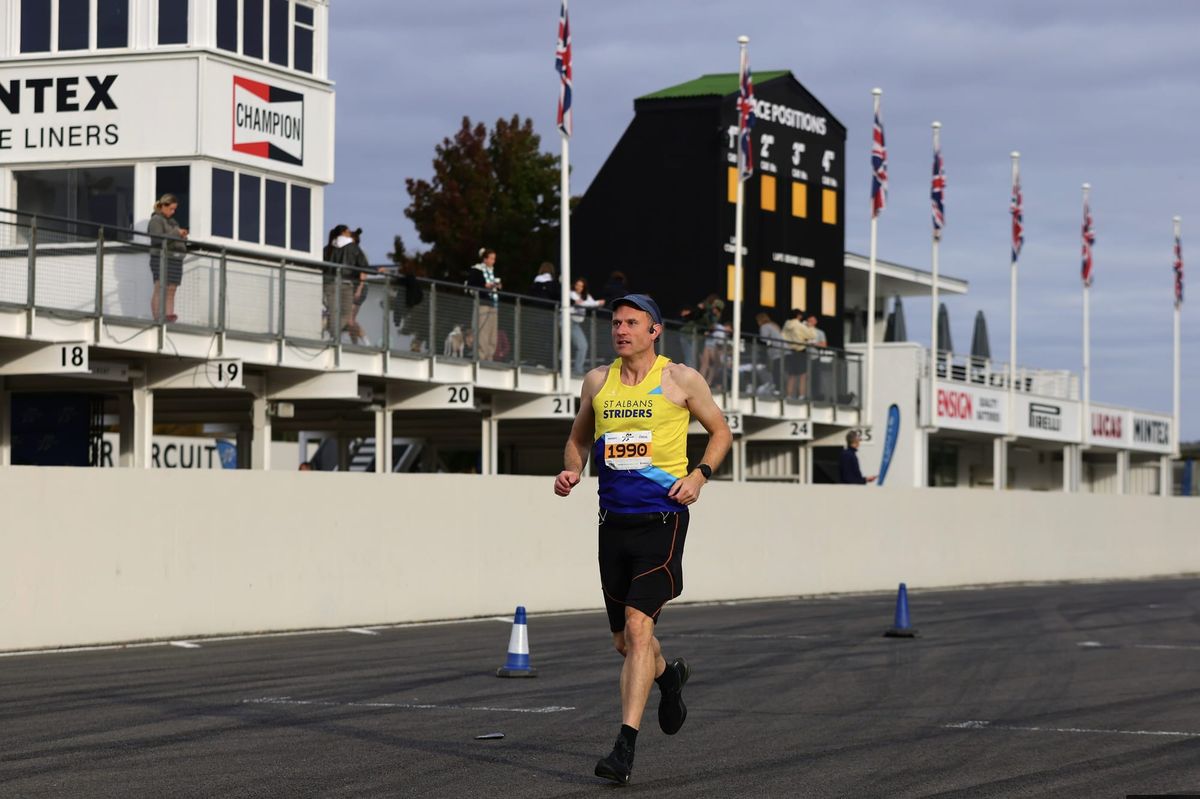
Having made my peace with the marathon in the spring, when I managed to surpass my A-goal of breaking 2:40 and secure a London Marathon Championship qualifying time, I decided to do something a little different this autumn.
I'm a road runner, and always have been. I much prefer the stability and predictability of tarmac to uneven, muddy or winding terrain, and I'm never happier than when running along a straight, smooth path, maintaining a steady pace and carefully monitoring my splits. My running playlist on my bone-conducting headphones provides enough variety to keep things interesting.
I'd noticed the emergence of 50K road races in recent years, particularly those organised by RunThrough in England, although there's also a prominent event in Perth, Scotland. The distance intrigued me, largely because I wanted to discover how far I could go before the wheels started coming off.
In the marathon, there's always the lurking fear of hitting the dreaded wall somewhere after 32km. Having now completed 10 consecutive sub-three-hour marathons, that fear has largely subsided, partly because I've developed confidence in the miles I've accumulated over the years, but also because experience has taught me that sensible pacing and regular, adequate fuelling can go a long way towards preventing a late-race collapse. I was curious to find out whether the same principles could be extended for another eight kilometres.
Why Goodwood?
I eventually settled on the Goodwood 50K, which takes place twice a year at the renowned Goodwood Motor Circuit in West Sussex. It's a chip-timed race on an officially measured course, with each lap covering approximately 3.8km and a well-stocked water station providing regular opportunities to take on fluids. Ultra purists might sniff at the idea of running 50 kilometres on tarmac rather than through forests or over mountains, but why should ultramarathons be exclusively the preserve of trail runners?
The circuit has a few gentle inclines and is relatively exposed, so strong winds could make for a challenging day. Fortunately, conditions for my race on 11 October were close to perfect: around 12°C, cloudy skies, a gentle breeze and no rain. Other distances, ranging from 5K to the marathon, were taking place on the same circuit, but the starts were sufficiently spread out and the track wide enough to accommodate everyone without too much weaving.
You will inevitably run slightly further than the official distance, particularly when overtaking other runners, but I found that by taking sensible racing lines I could keep the additional distance to less than 100 metres per 10K. For someone who likes predictable conditions and consistent pacing, it was about as good a venue as I could have hoped for.
So, for marathon runners contemplating their first road ultra, here are five things I'd recommend based on my experience.
1. Get comfortable spending longer on your feet
One of the biggest questions when stepping up from the marathon is how much additional endurance training you actually need. My view is that it's not necessarily about dramatically increasing your weekly mileage, but about becoming comfortable with both the distance you're covering and the amount of time you're spending on your feet.
Over the years, I've completed numerous training runs of 40–60km, based on a philosophy that marathon runners benefit from occasionally going well beyond the conventional 30–35km long run. These outings aren't about speed, and I certainly wouldn't recommend attempting them at anything approaching marathon pace. Rather, they're about familiarising your body with prolonged periods of running, so that the duration itself becomes less intimidating.
I hadn't undertaken an enormous amount of dedicated ultra training immediately before Goodwood, and my longest run in the final few weeks was only 32km. However, I was confident that my previous endurance work had provided a solid foundation. Not everyone needs to run 50km in training before attempting the distance, but having experience of running for several hours certainly helped me approach the race with confidence.
2. Practise running at your intended 50K pace
This was one of the more surprising lessons from my preparation. Thanks partly to the summer heatwaves, my running had slowed considerably over the preceding months, and my mileage was more about maintenance than building towards a specific race. In the weeks leading up to Goodwood, I therefore found it particularly helpful to spend some time getting accustomed to my intended 50K pace.
My easy runs are generally somewhere between 4:30 and 5:30 per kilometre, while my marathon race pace is around 3:40/km. Running at approximately 4:05/km occupied a slightly unfamiliar middle ground, and, strangely enough, during my first couple of training sessions, I found maintaining that pace almost as mentally and physically draining as running considerably faster.
But over two or three weeks, something clicked. The pace began to feel natural, and I found myself settling into it without constantly checking my watch or making minor adjustments. That familiarity proved invaluable on race day, when I wanted to concentrate on maintaining a consistent rhythm rather than continually calculating how fast I should be running.
3. Consistency is everything
Consistency matters enormously in the marathon, but I'd argue it's even more important over 50km, where the consequences of getting carried away early on can be particularly unpleasant.
My primary objective at Goodwood was to break three hours and 30 minutes, and I'd planned to maintain approximately 4:05/km on my watch throughout, perhaps pushing harder towards the end if I still felt strong. This also allowed for the fact that, even on an accurately measured course, you're almost certain to cover slightly more than the official race distance. The average pace required to finish 50km in 3:30 is 4:12/km, but I wanted a comfortable margin rather than risk missing my target by a few seconds.
On a circuit like Goodwood, maintaining that discipline requires a particular mindset, because you're sharing the track with runners competing over several different distances and at wildly varying speeds.
The trick is to treat the event almost as an individual time trial rather than a conventional race against those around you. Unless you're particularly fortunate, there probably won't be someone running at precisely your intended pace, and it's remarkably easy to find yourself speeding up to overtake someone or unconsciously following a faster runner. Or, indeed, copying someone else's slower pace.
I made a conscious effort to ignore what everyone else was doing and stick to my own rhythm. The result was an unusually consistent performance, with my pace barely fluctuating across the race and enough energy remaining to accelerate towards the finish. I finished in 3:26:02, comfortably inside my original target, with an official average pace of approximately 4:07/km over the measured 50km (my Garmin said I ran about 400m long, so the buffer I'd planned proved helpful).
4. Fuel, fuel and fuel again
I'm a firm believer that many marathon runners underestimate the importance of adequate fuelling, and stepping up to 50km only reinforces that conviction. Even if you're running at a slightly more comfortable intensity than you would over the marathon, you're asking your body to keep working for significantly longer, so getting your nutrition right becomes all the more important.
During marathons, I generally take an energy gel every 7km, but for Goodwood I increased the frequency to approximately every 5.5km. I carried everything with me, using the pockets in my running shorts and my trusty Camelbak belt, rather than leaving supplies beside the circuit and risking their disappearance. I also carried two 250ml Salomon soft flasks containing High5 caffeinated energy drink.
Having eaten a substantial breakfast about two and a half hours before the start, this meant I was entirely self-sufficient apart from the water available at the circuit's drinks station. I didn't need to rely on grabbing gels from marshals or remembering where I'd left my supplies, and could concentrate entirely on running. The added benefit of this is you literally get lighter as you progress in the race, which can help psychologically.
My advice would be not to scrimp on fuel, and to have a clear plan before you start. By the time you're beyond marathon distance, the last thing you want is to discover that you've underestimated your energy requirements.
5. Forget about the marathon finish line
This is perhaps the most important psychological adjustment. As marathon runners, we're conditioned to think of 42.2km as the finish line, and there's an understandable temptation to treat the additional 7.8km of a 50K as some sort of terrifying extension into the unknown.
I passed the marathon point at Goodwood in approximately 2:52, but made a deliberate effort not to dwell on it. I didn't want the final eight kilometres to become the psychological equivalent of the marathon wall, simply because I'd crossed the distance at which I'm accustomed to stopping.
Instead, I treated 50km as the distance I was racing from the outset. The marathon mark was simply another point on the circuit, no more significant than 30km or 40km, and I tried not to attach any particular importance to passing it.
Of course, this doesn't mean that the additional distance is automatically easy. But provided you've paced yourself sensibly, fuelled properly and prepared for the duration, there's no reason to assume that the wheels will suddenly come off just because you've run further than 26.2 miles. In my case, I was still running strongly at the finish, completing the final kilometre in approximately 3:47 - although I admit I wasn’t able to summon that kind of speed for the full final 3.8km lap as I’d thought I might be able to.
Is a road 50K worth trying?
I'm conscious that some, but certainly not all, of these observations will be relevant to trail ultramarathons, where elevation, terrain, navigation and other considerations can fundamentally change the nature of the challenge. A relatively flat 50K on a motor racing circuit is an entirely different proposition from covering the same distance over mountains, and I wouldn't pretend otherwise.
I'm also well aware that my experience at Goodwood wasn't comparable, in terms of effort, to racing a marathon absolutely flat out. My objective was to run a controlled, consistent race rather than push myself to the absolute limit, and I suspect I'd find it considerably harder to produce an all-out 50K performance without other runners competing at a similar pace. Interestingly, despite covering nearly eight kilometres further than the marathon, I also found that my recovery was considerably quicker, presumably because I'd been running at a more manageable intensity.
Road 50Ks remain a fairly niche pursuit compared with the marathon, but I think they deserve greater attention, particularly from runners who have already achieved their principal marathon goals and are looking for something different.
There's something rather satisfying about extending your endurance beyond the familiar 42.2km, not least because it provides an opportunity to test your pacing discipline, refine your fuelling strategy and discover how your body responds to running further than it's accustomed to racing.
For sub-three-hour marathon runners looking for a new challenge, I'd thoroughly recommend giving a road 50K a go, even if only once or twice. You might be pleasantly surprised by just how manageable those extra eight kilometres can be - and it may even make you a better marathoner.
Finding this useful? Help keep Sub-3 running — support us with a coffee.