Sydney Marathon 2026: Tenfold growth, a course record – but is it getting faster?
Sydney Marathon has grown from just 3,453 finishers in 2022 to more than 36,000 in 2026. Sub-3 has analysed five years of results to see what that extraordinary expansion has meant for the race – and for runners chasing a sub-three-hour marathon.
Sydney Marathon continued its remarkable transformation on Sunday, with a record 36,255 runners completing the race and Ethiopia’s Addisu Gobena setting a new course record of 2:04:42. Gobena edged compatriot Chimdessa Debele, who finished in 2:04:46, while Tebello Ramakongoana of Lesotho and Tanzania’s Alphonce Simbu both crossed the line in 2:04:57. Such was the quality at the front that the first seven men all ran faster than the previous course record of 2:06:06, set by Hailemaryam Kiros in 2025.
The women’s race produced another world-class performance, with Kenya’s Peres Jepchirchir winning in 2:18:31, just nine seconds outside Sifan Hassan’s Sydney course record. Irine Cheptai was second in 2:22:11, with Ethiopia’s Shure Demise third in 2:22:33.
For all the quality at the sharp end, however, the more remarkable story of Sydney Marathon may be what has happened behind the elites. In 2022, just 3,453 runners finished the marathon. Four editions later, that figure has risen to 36,255. In the space of five races, Sydney has gone from a relatively modest marathon to one of the largest in the world.
Sydney's extraordinary growth
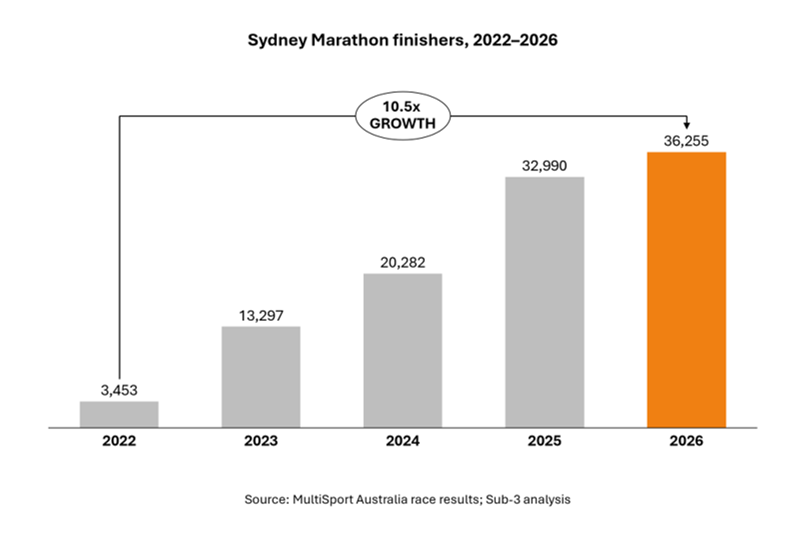
That represents an increase of almost 950 per cent since 2022, with the number of finishers now more than ten times what it was five editions ago. Much of that expansion accompanied Sydney’s successful campaign to join the Abbott World Marathon Majors, culminating in its elevation to Major status ahead of the 2025 race.
Yet growth on this scale raises an interesting question. Sydney is unquestionably bigger, its elite field is faster and its international profile is dramatically higher. But has it actually become a faster marathon for the thousands of amateur runners behind them? The Sub-3 data suggests a more complicated answer.
More than 1,300 runners break three hours
This year, 1,338 of Sydney’s 36,255 finishers broke three hours, equivalent to 3.7 per cent of the field. That is an enormous increase in absolute terms from 2022, when just 128 runners finished inside three hours, but the proportion of the field achieving the benchmark is almost identical.
Across the five editions, the numbers have developed like this:
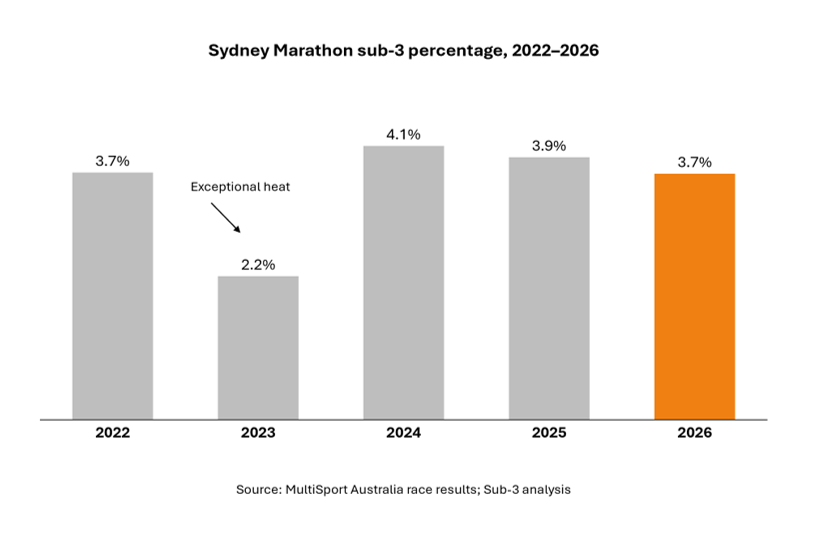
There is no obvious upward trend. Sydney recorded its highest sub-3 rate of the period in 2024, when 4.1 per cent of finishers broke three hours, followed by 3.9 per cent in 2025 and 3.7 per cent this year. Indeed, the 2026 figure is precisely the same, to one decimal place, as it was in 2022.
The conspicuous exception is 2023, when only 2.2 per cent of finishers broke three hours. There is a fairly straightforward explanation: the race was held in exceptionally hot conditions. Temperatures were already around 20°C at the start, rising rapidly through the morning and eventually reaching close to 30°C in central Sydney. The heat took a serious toll, with 26 runners taken to hospital and seven reported to be in a serious condition. Against that backdrop, the sharp fall in sub-3 performances is hardly surprising – and makes the relative stability of Sydney’s sub-3 rate across the other four editions more striking.
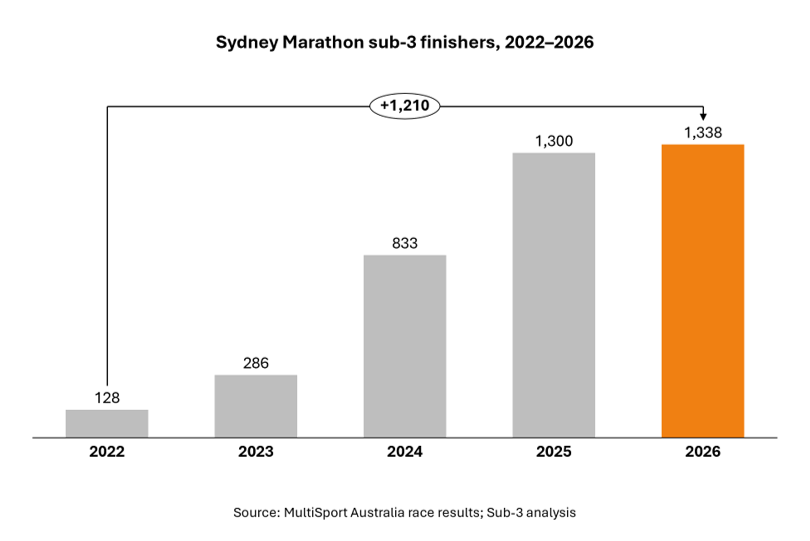
The broader picture is nevertheless striking. Sydney has become vastly bigger and significantly faster at the elite end, while its sub-3 density has remained remarkably stable. There are now more than ten times as many sub-three-hour finishers as there were in 2022 – 1,338 compared with 128 – largely because there are more than ten times as many people completing the race.
Is Sydney a fast marathon?
This distinction between scale and sub-3 density is particularly important in Australia. Sydney now produces comfortably more sub-3 performances in absolute terms than any other Australian marathon, but that does not necessarily make it the country's fastest race for an amateur runner chasing a time.
In the Sub-3 Fastest Marathons in Australia – 2026 Edition, Sydney ranked fourth on results from the 2025 season. Ballarat Marathon topped the Australian rankings after an extraordinary 17.34 per cent of its finishers broke three hours – 406 from a field of just 2,341. That performance also placed Ballarat sixth in the world in the Sub-3 World Marathon Rankings.
Gold Coast was another standout, with 887 of 12,707 finishers (6.98 per cent) breaking three hours, while Melbourne produced 806 sub-3 runners from 12,149 finishers (6.63 per cent). Both had substantially greater sub-3 density than Sydney, despite much smaller fields.
That illustrates why judging a marathon's speed from its winning time alone can be misleading. Sydney's 2:04:42 course record is now in genuinely elite international territory, but the experience of a 2:55 marathon runner is very different from that of the athletes racing at the front. Course profile, weather, congestion and – crucially – the composition of the field all influence the proportion of runners who eventually break three hours.
Sydney's transformation may itself help explain the apparent contradiction. Becoming a World Marathon Major has turned the event into a destination race for tens of thousands of runners with a huge range of abilities and ambitions. A smaller race such as Ballarat can have a much greater concentration of serious competitive runners without coming remotely close to Sydney's overall scale.
Bigger and faster – but in different ways
Five years of data ultimately tell two different stories about Sydney. At the elite end, the direction is unmistakable. The winning time has fallen from 2:07:02 in 2022 to 2:04:42 this year, and seven men running inside the previous course record demonstrates the extraordinary depth the race can now attract.
Among the wider field, the transformation is about scale. Sydney produced 1,338 sub-three-hour performances in 2026, compared with just 128 five editions ago, yet the percentage breaking three hours has ended up exactly where it started: 3.7 per cent.
That is hardly a criticism of the race. If anything, it captures how rapidly Sydney has changed. What was a relatively small Australian marathon five editions ago is now a global mass-participation event capable of attracting more than 36,000 finishers and some of the fastest marathon runners on the planet.
Sydney has unquestionably become bigger. At the front, it has become faster too. For the sub-3 runner, though, the evidence suggests that size, prestige and elite speed are not quite the same thing as a fast marathon.
Finding this useful? Help keep Sub-3 running — support us with a coffee.