Marathon hydration is hard enough already
New York City Marathon’s new bottle refill stations are being introduced alongside conventional water stations. But Paris has shown where the drive to eliminate disposable cups can lead, and sustainability should never take precedence over performance and safety.
New York Road Runners has announced that this year’s New York City Marathon will feature self-service water refill stations for the first time. Five will be positioned around the course, at miles eight, 14, 17, 20 and 23, allowing runners carrying their own bottles, cups or hydration vests to refill them with filtered water. Crucially, these will complement rather than replace New York’s 25 traditional fluid stations, so runners who want to use them can do so while everyone else can continue grabbing a drink in the conventional way.
Taken on its own, that seems perfectly reasonable. I am not a refusenik when it comes to carrying my own hydration: I routinely race with a 250ml Salomon soft flask, which means I am less dependent on getting a good drink at every aid station. But 250ml is nowhere near enough to get through a marathon, and nor would I want to carry enough water from the start to make myself completely self-sufficient. For most runners, including those who carry some of their own fluids, reliable on-course hydration remains essential.
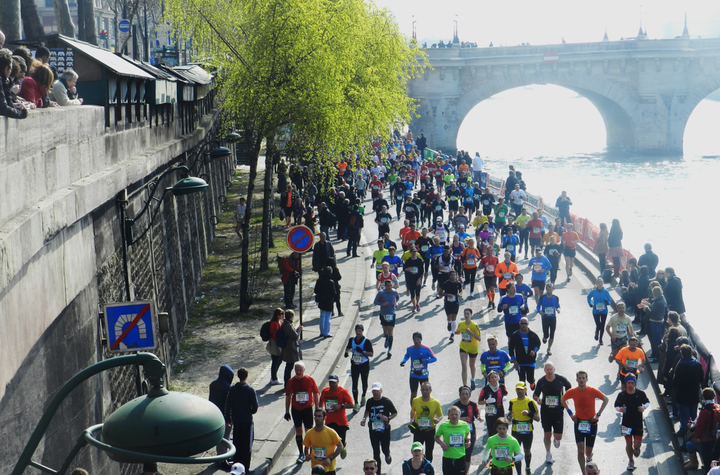
It is difficult to look at the New York announcement without thinking about what happened at the Paris Marathon earlier this year, when organisers went much further and removed both cups and bottles from aid stations. Runners instead had to carry their own container and refill it along the course. What is an optional extra in New York has effectively become compulsory in Paris.
That is why the direction of travel matters. NYRR explicitly places the new refill stations within its broader sustainability strategy and its ambition to reach Net Zero emissions by 2040. If refill stations become normalised, it is not difficult to imagine organisers asking whether they still need to provide quite so many disposable cups as well. Perhaps 25 conventional stations become 20, then 15, before someone eventually asks why they are needed at all. Paris has already shown that this is not an entirely hypothetical concern.
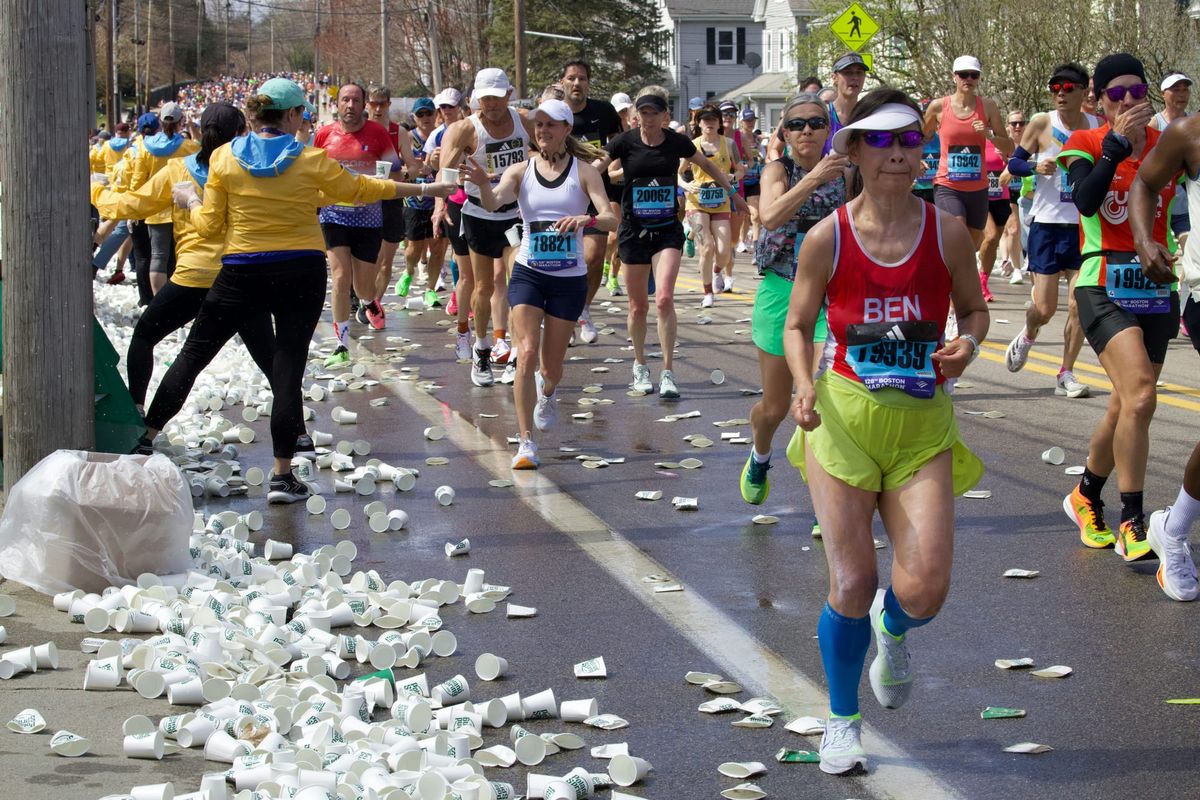
The problem is that hydration during a race is difficult enough already. I was reminded of this while racing the Copenhagen Half Marathon as part of the World Athletics Road Running Championships on Sunday. Running at around 3:35/km, I found the paper cups difficult to collect cleanly and even harder to drink from properly. You approach the table at speed, often with other runners around you, grab a flimsy cup and then attempt to get a reasonable quantity of liquid into your mouth without slowing too much or spilling most of it down yourself.
The only really good drink I managed all race came from a plastic bottle. The elites had already passed and some bottles were going spare, so one was handed to me. It was a godsend. I could keep running, drink carefully in my own time and then pour what remained over my head to cool myself down. That is vastly easier than trying to swallow water from a paper cup, and the experience made me think race organisers should be looking at ways to make hydration more convenient for runners, rather than starting from the objective of eliminating the most convenient methods.
A video promoting New York’s new refill system has gone viral in recent days, claiming that it “literally takes 1.3 seconds” to refill a bottle. But the time it takes for water to come out of the tap is hardly the relevant measure. Watch the runner and she has to move towards the station, slow substantially, break stride, position her bottle beneath the nozzle, fill it and then accelerate back to running speed. The whole process appears to cost considerably more than 1.3 seconds and, perhaps more importantly, interrupts the rhythm of someone trying to race.
The demonstration also takes place with clear access to the refill point. New York is one of the largest marathons in the world, with nearly 60,000 runners, and the experience could be rather different when multiple runners arrive at the same station at once. Even with several taps available, there is obvious scope for hesitation and congestion, particularly if runners have to slow sharply in front of those approaching from behind. For someone chasing a time, several such interruptions over the course of a marathon could make a meaningful difference.
As one sub-3 aspirant responded online: “What’s stopping me? The clock... I finished Boston in exactly 3:00:00 last year. This is a great option for runners who want it, but please don’t pretend stopping to refill a bottle works for everyone who’s racing for time.”
None of this requires accepting unnecessary waste. Indeed, New York itself demonstrates some of the alternatives. NYRR says that 107.99 tons of water and Gatorade cups were composted in 2025, while this year’s wider sustainability programme includes electric and hybrid support vehicles, race shirts made from recycled polyester, clothing collection and food donation. Those initiatives tackle the environmental impact of staging a huge event without asking runners to compromise the way they race.
Organisers should reduce waste wherever they reasonably can, including improving the materials used for cups and making sure they are properly collected, recycled or composted afterwards. But the mechanics of the race itself, particularly something as fundamental as hydration, should be designed first and foremost around what works best for runners. Sustainability measures should work around the demands of the race, rather than requiring runners to adapt their racing to meet environmental targets.
New York has not yet got that balance wrong. Five additional refill stations simply give runners another choice, and some may find them genuinely useful. The concern is that they become a staging post towards something more restrictive, particularly as organisers pursue increasingly ambitious environmental targets. Paris offers a warning of where that can end, with a system intended to make hydration more sustainable ultimately changing how every runner has to manage one of the most important parts of their race.
Marathon hydration is not a problem we have solved. Even traditional cup stations can be awkward at speed, as Copenhagen reminded me at the weekend, while bottles remain one of the simplest and most effective ways of drinking properly on the move. Rather than making hydration progressively less convenient in pursuit of Net Zero, organisers should be trying to make it work better while dealing intelligently with the waste it creates.
Finding this useful? Help keep Sub-3 running — support us with a coffee.