How Claire Howard broke three hours as a frame runner
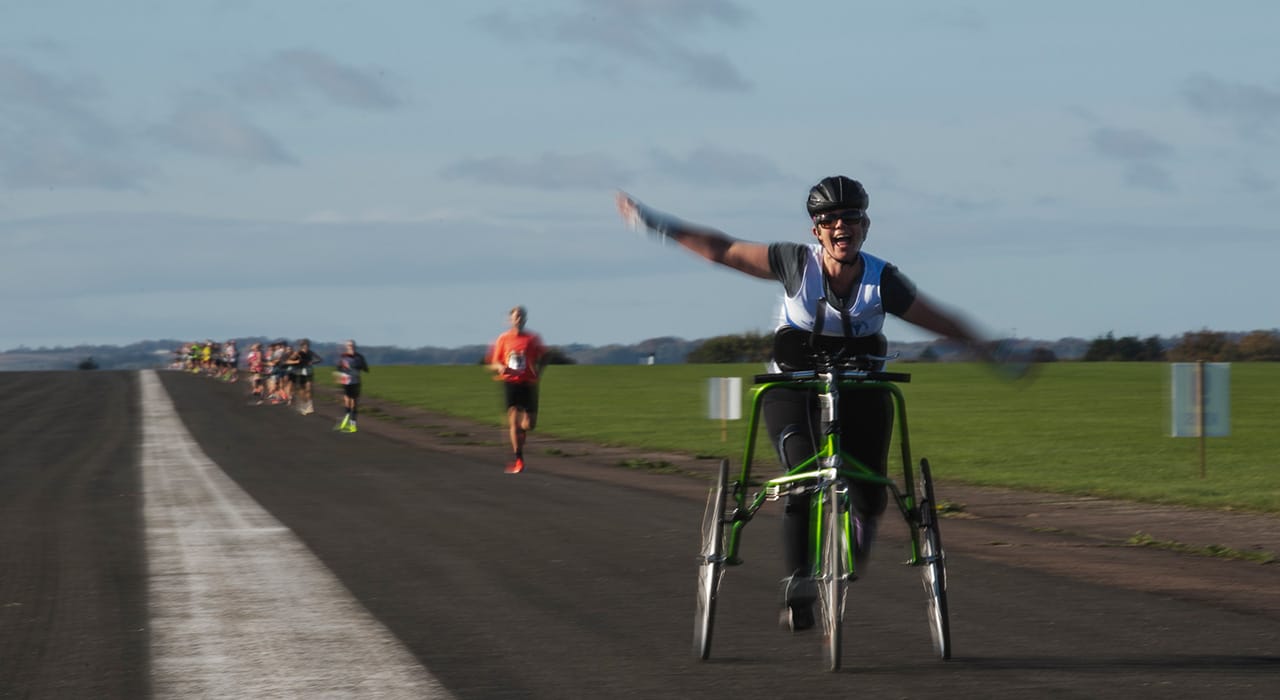
Claire Howard only discovered frame running a few years ago, but has already become the first known female frame runner to break three hours for the marathon. In this Q&A, she reflects on training, racing, congestion, equipment problems and the freedom she has found through the sport.
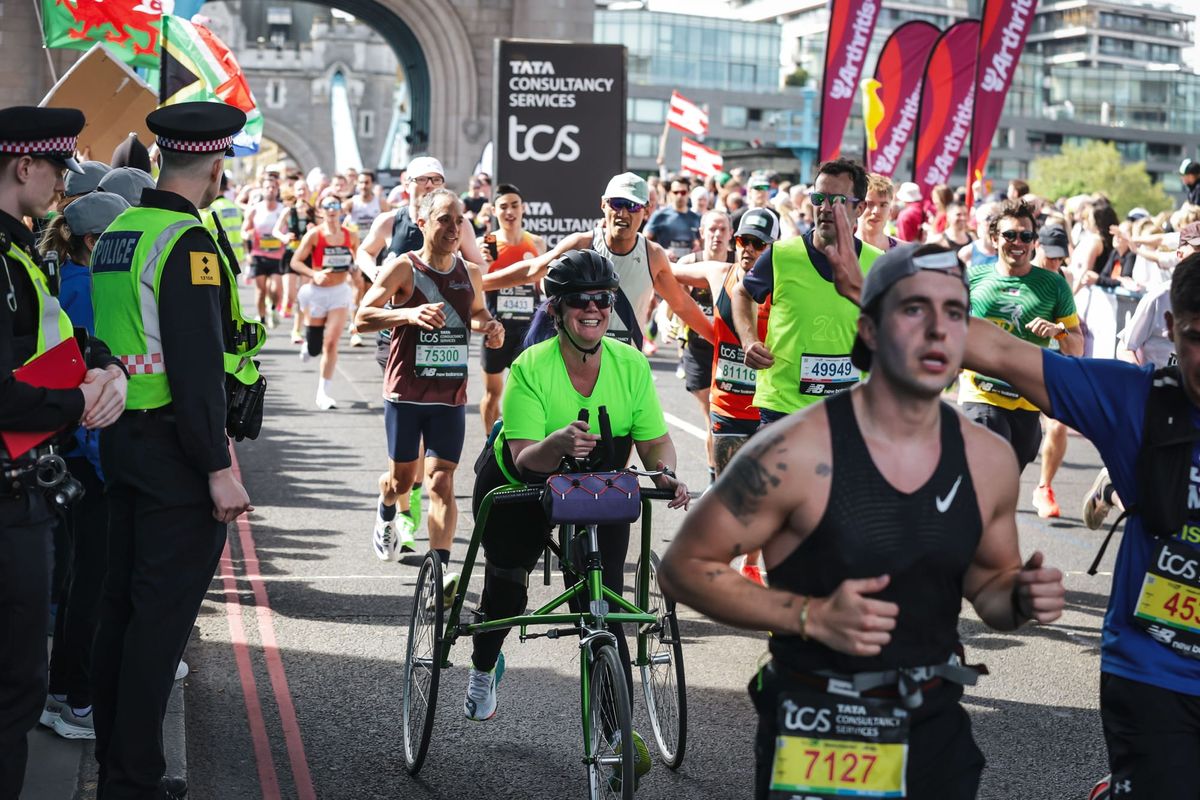
Claire Howard became the first known female frame runner to break three hours for the marathon when she ran 2:58:59 at the 2026 Manchester Marathon, averaging 4:15 per kilometre across the full 42.2km distance. Just a week later, she completed the London Marathon in 3:19.
Hertfordshire-based Howard, who has a physical disability affecting her mobility, only discovered frame running a few years ago. The sport remains an emerging endurance discipline, with relatively few athletes attempting the marathon distance. Some organisers - including Boston - still won’t let her participate.
Here, she explains how she discovered frame running, the challenges involved, her approach to training and the advice she would give to others who may find freedom through this branch of the sport.
Q: How did you first discover frame running, and what made you want to try it?
One of my friends persuaded me to take part in the Superhero Triathlon, which is an incredible inclusive triathlon held annually at Dorney Lake. It was during this event that I first saw someone using a frame runner and I thought it looked fun.
The company who distributed them in the UK was lending them to people to allow them to take part in the event and they very kindly let me have a quick try on one. I loved it!
Let’s just say within a few hours of being home, I had already done some research and reached out to Cambridge and Coleridge Athletics Club (C&C), who were my closest group with a range of frame runners that club members could use during sessions.
I took part in my first session in September 2022 and absolutely loved it.
Q: What has frame running given you that you didn’t have before?
Frame running has given me the opportunity to run with friends - something I had been unable to do previously. Some of the events that stick out most for me have not been my PBs, but the ones where I have taken part with a friend and we have managed to run next to each other the whole time.
It has also allowed me to take part in organised running events. There is no way I would ever have thought I could complete a marathon - let alone two a week apart.
It has also given me a physical challenge to aim for and brought out a competitive side in me that I didn’t realise I had.
Q: Can you talk us through your training for Manchester? What did a typical week look like?
My training for Manchester started a few weeks later than planned due to the icy spell we had at the beginning of the year. From there, I gradually built up my runs each week, alongside an interval session with C&C.
As I had a target time in mind, I downloaded the Runna app to see what their training plan looked like, and I was a huge fan of my watch telling me what to do and for how long. I didn’t rigidly stick to the plan, but used it as a rough guide and it seemed to work.
I also tend to enter a few events during training - it’s one of the ways I make sure I push myself, and as the mileage gets higher, the reward of a medal helps!
Q: How does marathon training as a frame runner differ from standard marathon training?
For the target finish time I had in mind, my average mileage was relatively low, peaking at about 35-40km a week. It’s a very fine balance between getting enough miles in and not overdoing it, which would leave me unable to walk while my leg recovered. It’s a balancing act for all runners, but for me the threshold seems to be much lower, so I just have to listen to my body and work around that.
The other difference is that I can’t just run out of my front door. The frame runner needs a fairly even surface, and paths need to be suitable to run on. I did a lot of my runs on a running track as it’s a more suitable surface and a safer environment, but I do find that mentally tough.
Frame runners are really easy to tip over due to their high centre of gravity, and as I am unable to get up if I tip it over due to my disability, I need to make sure I am always somewhere that someone can assist me should I encounter any difficulties. The husband also insists that I only run where an ambulance can easily get access to!
Q: When did you first think a sub-3 marathon might be possible?
In 2025 I trained for my first marathon, which was Manchester, and I was going to be really happy with a sub-4 time. Somehow I finished it in 3:08, so I thought then that maybe if I stopped to chat less, sub-3 might be a possibility - although I also had no idea where that time had come from!
I think it was when I completed a half marathon at Dorney Lake in 1:23 that I realised it might actually be possible, as it was far from ideal conditions, with a strong headwind for half the course and much colder weather than I like.
Q: How did Manchester unfold on the day - and were there moments when sub-3 felt in doubt?
The first few miles were as expected - busy and impossible to get past anyone. But as I have a tendency to go off too fast, this was not the worst thing and meant my pace was only slightly behind where I wanted to be at that stage.
The congestion lasted longer than I was expecting and it is hard to manoeuvre a frame runner through crowds of runners, which I was beginning to find frustrating, as I could often see a clear bit of road - I just couldn’t get to it.
I reached halfway and felt good. I was still enjoying myself and was spot on target in terms of timing. Due to dislocating a couple of my fingers earlier in the week, opening gels was difficult and meant I did not take on as much fuel as I should have done.
When I am on the frame runner, I balance on a bike saddle - and these are not designed for the movement of running, so I have to be careful to regularly apply cream to avoid too much chafing. I reapplied some just after mile 20 and hoped that would see me through to the end.
Let’s just say it did not see me through to the end. I spent a good kilometre or two debating with myself - do I stop and lose time, knowing I was already behind my target pace, or do I just suffer and keep going?
I chose the latter, which in hindsight was probably not the right decision, as the pain was awful for the last two miles and I probably could have picked up the pace if I wasn’t in so much pain.
It was at this point that I thought sub-3 was out of reach and it was hard to keep pushing. I think by then, the overarching emotion was just that I wanted to get off the frame - and the faster I ran, the quicker I could get off!
It was only later in the week that we realised no-one had pumped up my tyres properly before Manchester. I thought the husband did it and he thought I did it… which probably explains why it felt so tough! It’s definitely a lesson learnt for future events though.
Q: You completed the London Marathon just a week later. How did that compare, and how did your body cope?
I was always in two minds about whether two marathons a week apart was actually a good idea, but the thinking was always that if I achieved sub-3 in Manchester, then I could relax and enjoy London. If not, then London would become another sub-3 attempt.
When I started London with my fantastic support runner - which was a game changer - we were very glad we were not trying for sub-3, as the course was so congested and there was very rarely an opportunity to even let runners know you wanted to pass them because the crowds drowned everything out.
So we took the opportunity to enjoy the running and soak up the atmosphere. To finish in 3:19 felt unbelievable, as it did not feel like we had been running at that pace.
Q: Who has been most supportive of your frame-running journey so far, and how have race organisers responded?
I’d have to say my husband. Not only does he put up with me being out training and getting up early for events, he is also my go-to if anything on my frame needs attention or fixing.
I will be forever grateful to the C&C disability group. Without them, I would not even have been able to start my frame-running journey, and the knowledge and support of the coaches there is what pushed me to where I am now.
I was pleasantly surprised with how supportive London Marathon were. They made the day so much easier, with parking at the start to drop me and my frame off, parking near the finish line, a support runner and easy access to the start line.
Other race organisers have been more mixed, with some being very supportive and others not so much. One of the most frustrating requirements from some events is having to start from the back of the field or wave, which is actually the most dangerous place for most frame runners to start. It is still a relatively new sport and hopefully race organisers will continue adapting to allow more frame runners to take part.
Q: What advice would you give to frame runners just starting out - and to those hoping to race seriously or even chase sub-3?
I’d have to say just give it a go. There are a few clubs dotted around the country where you can try it without having to purchase your own frame runner, and I am confident you will love it.
For those wishing to take it more seriously in terms of road and distance races, I would say exactly the same thing - just give it a go. You never know what you can achieve until you try.
I have no idea what comes next for me. I was looking at doing the World Majors, but Boston have already said they won’t let me take part, so I am looking for a new challenge now!
Claire Howard is an ambassador for the Herts Sport & Physical Activity Partnership No Limits 2026 campaign. Visit here to find out more.
Finding this useful? Help keep Sub-3 running — support us with a coffee.