100 marathons. Sub-3 across three decades.
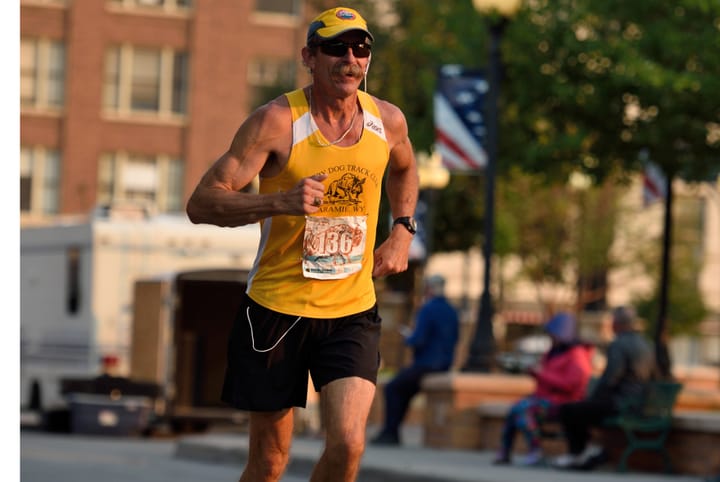
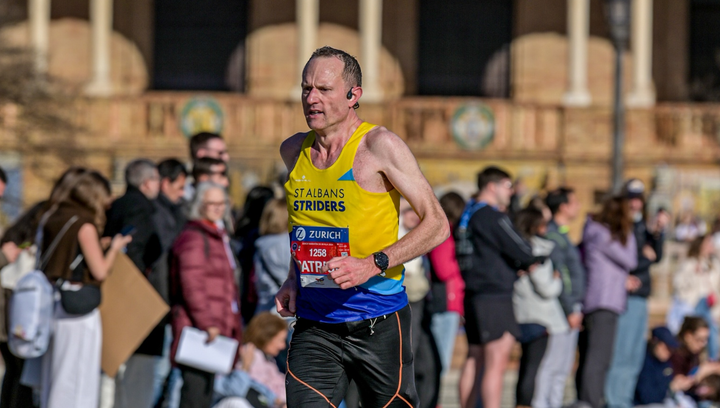
Richard Ginn has run 100 marathons, including 46 under three hours, and competed for England Masters well into his fifties. In this long-form reflection, he sets out how he has trained, raced and recovered over decades of competitive marathon running.
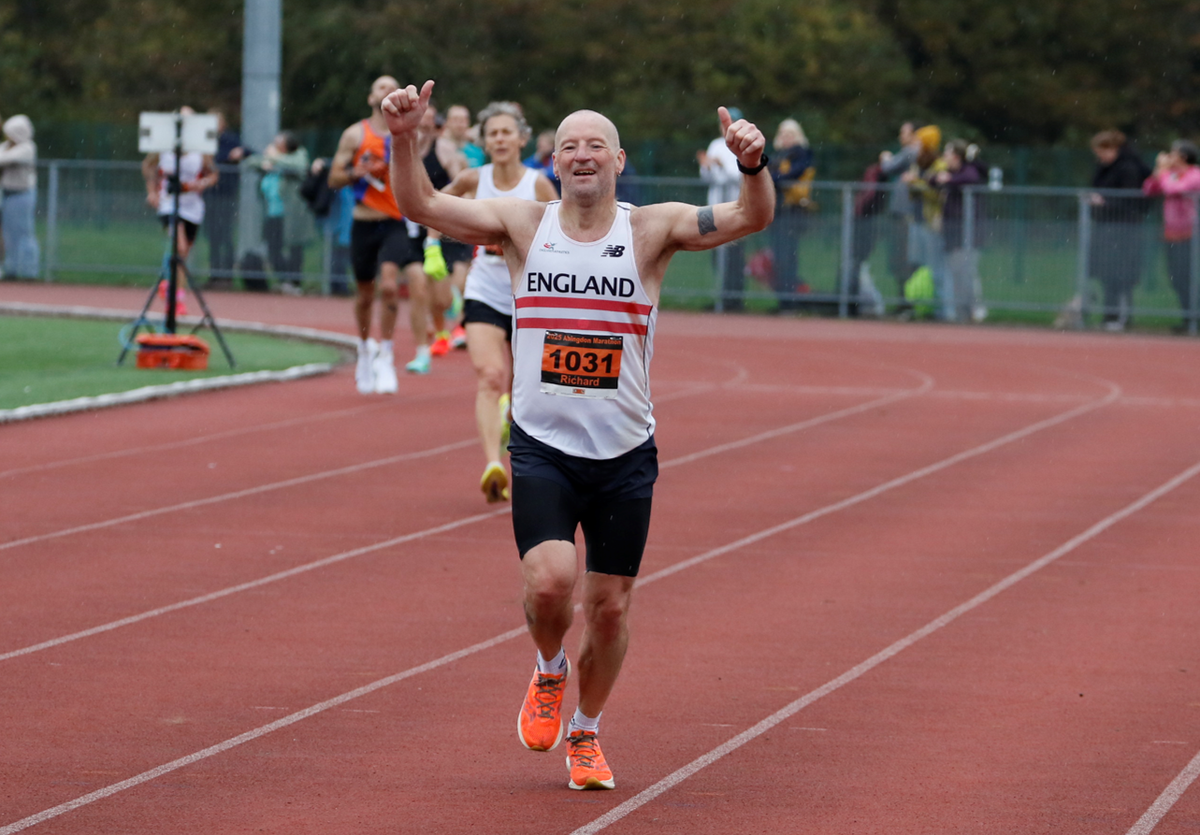
How I started running
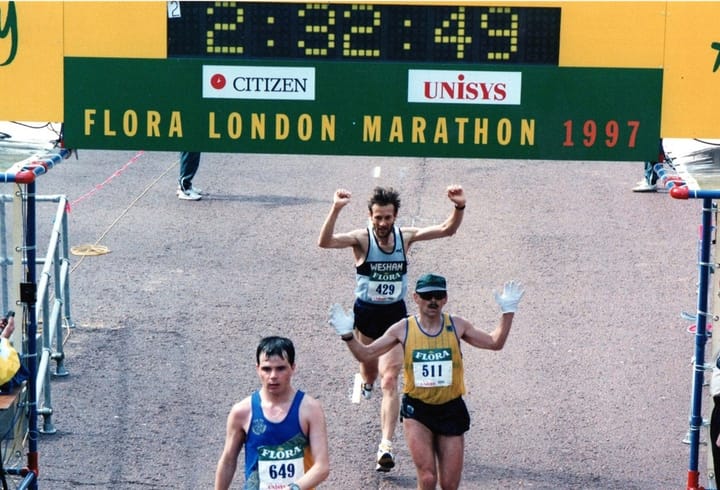
My name is Richard Ginn, I’m now 55 years old. I started running in about 1997. A friend at work was running the London Marathon and wanted a few of us to keep him company on lunchtime training runs. We were all playing squash and using the gym together at the time. I was nearly 15 stone then, as I enjoyed my food and beer a bit too much.
We started doing some three or four mile runs at lunchtime, which were hard work to start with. I realised I was enjoying the cardio work much more than the weights in the gym and I was starting to get to balls on the squash court I didn’t before. This led to a change in diet and exercise focus, which resulted in dropping about three and a half stone in just over seven months, and I have not looked back since.
My training shoes of choice are Saucony Kinvara and Saucony Fastwitch for racing. I have a pair of carbon plate Saucony Endorphin Pro 2, which I have used for a few target races in the last couple of years. I just never got onboard with the supershoes thing.
“Rock up, run as fast as you can, see what happens.”
My racing philosophy is rock up on the day, run round as fast as you can on the day, see what happens. Sometimes the fastest you can run on that day is not as fast as you hoped it would be – accept and learn from it, then move on to the next race.
Racing for so many years does mean that I am quite relaxed about racing, so I enjoy a beer or two the night before a big race and eat a proper meal. I try to be in bed by 9.30pm ready for the inevitable early start. Breakfast is porridge and berries, followed by a banana and electrolyte drink about 60–90 minutes before the race. I take a couple of High5 gels five minutes before the start, then four or five across the marathon from about an hour in. I drink water to thirst across the race and get around quick so you can get the beer and cake first.
Running friends do jokingly call me a machine and bombproof for being able to put in consistent back-to-back performances and remain relatively injury free. I have been lucky that genetics and biomechanics have been kind to me to give me the potential to do well. They provide a big head start, but putting in the hard work and dedication is what really counts. I’m still somewhat surprised at how well I have done over the years.
I always keep in mind that races are not all about the top few per cent, but more about the back of the pack runners who turn out knowing it’s going to be a long slog, but still give it their best go. Running a sub-three marathon is, in some respects, easier than being out for five or six hours. Anyone that finishes is a winner in my book.
Longevity, genetics and enjoyment
I have been incredibly fortunate to run sub-three for almost half of the marathons I have done. Physically, part of this has to be the luck of genetics, the rest hard work. I did a lot of weight training in my twenties (combined with a poor diet). When I switched to running in my late twenties I was able to retain a fair bit of muscle tissue, which I have retained over the years.
I’m far from the typical distance runner physique at 5’6” and struggle to get below ten and a half stone. I’m stocky, with shortish powerful legs that have to turnover fast to keep up with taller runners.
“If you’re not enjoying it, you will not reach your potential.”
Mentally, I enjoy being out for a run. With a mostly sedentary and often mentally intensive job, I find the running meditative and a complete opposite to work. I don’t listen to anything while running outside, so just me and the elements is therapeutic. I suppose you have to really enjoy running to get the most out – if you’re not enjoying it, you will not reach your potential.
Lifestyle has changed the most over the years as family life shifts and grows. Being flexible and adapting your routine to fit the new dynamics is important, while still being able to keep some defined long run time.
Training approach
I will alter my training as I approach a marathon, but I usually maintain a relatively consistent training load across the year, aiming to be at a level where I could run a 3:15 marathon relatively comfortably at any point of the year.
My training mileage is quite low for someone running the sort of times I have done. A typical week would be 30–40 miles, up to about 50 miles when in a building block.
“Cycle commuting and walking wherever possible — that’s my free training.”
On top of this I have cycle commuted for the last 30 years, so will cycle about 75–90 miles a week, and walk wherever possible. These activities replace some long slow and recovery runs and are ‘free’ training as they are built into my routine.
I’m fortunate to have access to a workplace gym, so I will try and manage a couple of treadmill interval sessions a week to work on speed. When I can, Parkrun is also a great way to get in some speed work, combined with running or cycling to a local one.
Injury resilience
I think I have been incredibly lucky to have not been injured very much over the years. I’ve had hamstring injuries about three times in the last 15 years. Genetics and biomechanics have been kind to me, with few injuries and little in the way of ill health.
I do have a physio sports massage once a month, which seems to help. Not exclusively running has probably helped a lot in avoiding overuse injuries, being able to spin my legs out on the bike rather than getting out for a slow run when you don’t feel massively up for it. A bit of gym work to develop leg and core strength after a treadmill session also seems to help.
Listening to your body is important for injury prevention. Basically, if it hurts, stop. We all have days where you’re just not up to a run – knowing which are just in your head and getting out anyway helps mental resilience. On the days it’s your body talking, listen and take it easy or just bin it off and don’t worry about it.
Motivation
A lot is probably just habit now. Thirty-odd years of cycle commuting in all weathers toughens you up, and I find if I don’t do anything for a few days I get a bit ‘itchy’ and want to get out.
Being at a desk most of the day, getting out for a run is liberating. Being in my own headspace with no distractions for an hour or two on a run or cycle could be considered one of my ‘happy places’.
I enjoy racing still and mostly compete against myself. Local races where I know plenty of other runners will be against those in my age group and those of a similar pace.
I have a good-natured nemesis who is a few years younger, who I just try and keep in sight. Winning my age group at races is definitely motivating, shame I can’t retire on the occasional £20 prize money.
I use a free, pay-as-you-feel website (www.fetcheveryone.com) which has a few GPS-based games you play against others. It’s a bit of fun, but makes you think about routes to get the most points and beat an opponent.
The age groups
In the open category I probably did OK, but when you’re racing against people 15–20 years younger it’s tough. My training probably improved in the late 2000s, so when I hit 40 and the age groups I was getting into the top five or six, which was a surprise and helped to motivate me.
In the backend of 2013, a clubmate who was a UKA-qualified coach offered to set myself and a few others at the club a training plan. The structure helped immensely and saw some huge leaps in performance over the years. The coaching continued for seven or eight years until his work commitments increased and he had to step down.
The hard work led to the 2015 London Marathon, where I managed to run my first sub-2:45 by eleven seconds, which at that time qualified me for a Championship place for the first time. I ran London again in 2016, 2017, 2018 and 2019.
From there, the 2016 Yorkshire Marathon, where I ran a 2:49, placed me in the top three for my age group (VM45) and gave me a qualification for the England Athletics Age Group Marathon team for 2017 at the Chester Marathon.
I have been incredibly fortunate to have run in an England vest seven times at marathon distance and twice at half marathon distance since then. I have also been incredibly lucky to have done so well in the age group categories. In some respects it is easier to race in, as you are competing against a subset of the field, albeit a very competitive subset.

Sub-3 standards
Experience helps enormously with marathon running, as you know how hard it can be. There are fewer surprises when running and I find I can be quite relaxed about racing, although the last hour before a big race is still the toughest, as I don’t quite know what to do with myself.
Pacing and strategy become more second nature, but it can still all go wrong on the day (and sometimes does), no matter how much experience and knowing better you have.
Racing many of the Masters age-group qualification races over the past decade has been good, as it attracts some very good runners who are all aiming for times in the 2:40–55 region. That certainly pushes you along, as the field can be very competitive.
Running sub-three is never ‘easy’. It requires a lot of hard work beforehand, on the day, and a bit of luck on the day as well. Experience and training help to mitigate many of the known variables, which improves your chances and makes the effort far less daunting. But you still need to be prepared for it not going well on the day and to shift expectations to fit the day.
Triathlon and ultras
I enjoy triathlon and it was more of my focus in the 2000s. I was a mediocre swimmer, a fairly good cyclist and it turned out I was a pretty strong runner by triathlon standards.
I have raced ten Ironman-distance events with a PB of just over ten hours, as well as double iron twice, triple iron once and quintuple iron once.
Ultras are a completely different beast to running marathons. I have raced the Lakeland 100 six times and have a 100 per cent finish rate, with a PB of 35hr35min. Events like that require a good measure of mental toughness and do make a three-hour marathon feel like a short run out.
Early on, triathlon probably got in the way of serious marathon running. Changing family circumstances and the cost of Ironman-distance events shifted my focus to mostly running. Ultras mostly fall outside the spring and autumn marathon seasons, and I base ultra training on my marathon training, as there is not really a way to train running very long distances and still have any work–life balance.
High frequency racing
I’m 55, not far off 56 now. I thought running three or four marathons a year was fairly normal, possibly having spent too much time with people who enjoy ultra running, triathlon and 100 marathon club prospects.
Since 2008, apart from 2020, three a year has been the minimum and nine the maximum. 2015 was the most: April, May and June, followed by August with four in four days, then September and October.
After a race I will walk around for a while to keep the blood flowing, then keep the next few days easy, usually back on my bike to work and back. I’ll have a gentle jog three or four days after the race and keep things light for a couple of weeks before getting back to normal intensity.
“Some of my best performances have come with one to three weeks between marathons.”
Some of my best performances have come with one to three weeks between marathons. My coach believed in a super hard effort ten days out followed by very easy days before a big marathon, so two weeks between races appears to work for me.
Manchester 07/04/19 and London 28/04/19 (2:41:51 and 2:41:35), conditions were good for both races and everything came together. Then in October 2023, Chester and York were a week apart (2:49:47 and 2:41:18 PB).
Lots of active recovery, walking and cycling seem to work for me, and I’m not afraid to bin off a few days if I don’t feel up to it.
Advice to aspiring sub-3 runners
Keep a balanced training load across the year. Listen to your body – if it hurts, stop.
Learn to accept a certain level of discomfort in hard training sessions. Don’t be afraid to cross train (triathlon isn’t a dirty word).
Learn to run without music or podcasts, enjoy the peace and get used to being comfortable in your own headspace for a few hours.
Don’t let a race get in your head. Have realistic expectations and be prepared to change them due to circumstance.
“Remember that what feels like a poor race performance to you may be someone else’s PB dream.”
Have a go at an ultramarathon (there are plenty of 30–50 mile events). It is quite liberating to just run long without worrying about chasing a time, will build endurance, and three hours will fly by.
Always thank marshals and volunteers during a race. Encourage slower runners on lapped courses.
Remember that what feels like a poor race performance to you may be someone else’s PB dream, and be thankful you have the ability.
Finding this useful? Help keep Sub-3 running — support us with a coffee.