Why does sub-3 matter?
Breaking three hours isn’t just about bragging rights. It’s about testing your discipline, finding clarity in the grind and pushing past a line that means nothing - and everything.
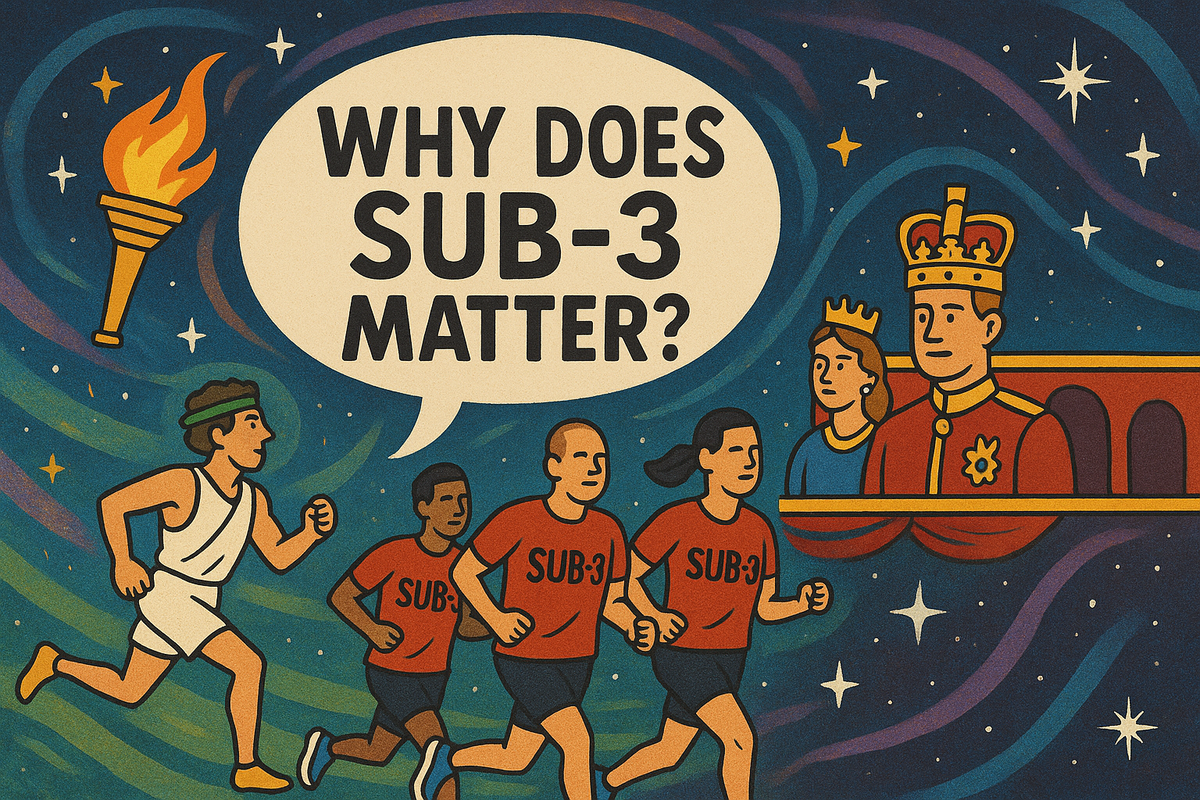
Running a sub-3 marathon can become a lifetime quest - an obsession that soaks up thousands of pounds, countless hours on the road and often the kind of social sacrifices people outside the sport find hard to fathom. But why does it matter so much? Why has defeating this specific round number become such a powerful goal for so many runners?
Part of the answer lies in our relationship with numbers themselves. We love round-number thresholds: they’re simple, clean lines that cut across the messy continuum of human effort and create a clear marker between success and failure, ordinary and extraordinary. This isn’t unique to running - we see the same phenomenon in weightlifting (lifting triple digits), sprinting (breaking 10 seconds in the 100m) or even the school system (the difference between a score of 69% and 70%). Something about our psyche craves these clear lines that divide the world into pass and fail, elite and ordinary. It’s a way we seem to try to understand and navigate the world. But this could be said about any time-based goal, not just the marathon.
The marathon itself is a perfect example of how something arbitrary can gain mythical status. The origin story is famous: after the Battle of Marathon in 490 BCE, the messenger Pheidippides supposedly ran from the battlefield to Athens to deliver news of victory before collapsing and dying. But the precise modern distance - 26.2 miles - comes not from ancient history but the whims of the British royal family, who wanted the 1908 Olympic marathon to start at Windsor Castle and finish in front of the royal box. That random adjustment stuck and became the standard. It’s a reminder that even the most hallowed traditions in sport often rest on arbitrary foundations.
Yet arbitrary doesn’t mean meaningless. In fact, it’s precisely because these lines are human-made that they take on power: they become tests of our will, our discipline, our ability to transform pain into something we can point to and say: “I did that.” Famously, when asked why he wanted to climb Everest, George Mallory replied: “Because it’s there.” The urge to set a challenge and conquer it.
Sub-3 is one such line. It’s just hard enough to demand real sacrifice, consistent training, discipline (and it must be said a certain amount of natural genetic ability). Yet it’s not out of reach for most - especially for those willing to work hard to fit all their training into their lives to achieve the goal. There’s a pretty well-established blueprint to get to sub-3 now. That combination is what gives it such pull. If it were easier, it wouldn’t mean much. If it were impossibly hard, most people wouldn’t even bother trying. Sub-3 falls into that sweet spot.
And there’s data showing just how real this psychological power is. Look at the finishing distributions in any big city marathon - Berlin, Boston, London - and you’ll see a noticeable spike just under 3:00 and a drop just after. That’s not because runners naturally cluster around that time, it’s because the symbolic importance of sub-3 drives people to find reserves of energy and willpower they might not otherwise discover. They’ll surge in the final mile and start sprinting, even risking collapse, just to get under that barrier. They’ll summon their final reserves and dig deep. 2:59:59 means something. 3:00:01, somehow, does not. It seems mad - and in a way it is - but we imbue it with meaning both as individuals but also culturally.
So why does it matter so much practically? Beyond the personal satisfaction, running sub-3 carries real weight in the running world. It’s near-universally recognised as a mark of serious amateur excellence - despite the rise of carbon shoes - shorthand that says you’ve put in the work, you understand the sport, you’re not just dabbling. It often opens the door to new communities, coaching circles and conversations where a sub-3 badge instantly grants respect. It’s like getting a first from university - but actually much rarer (around 2.65% of marathon performances are sub-3 each year).
Physically, the training required to break three hours brings enormous benefits. Higher mileage over months and years typically builds a stronger aerobic engine, lowers resting heart rate, increases muscle endurance, improves running economy and often results in lower body fat percentages. If approached sensibly, the process can be good for long-term health, supporting stronger bones, improved cardiovascular function and reduced risk of many age-related diseases. As a regular sub-3 runner, my Garmin - not the ultimate arbiter of such things, I know - says my “Fitness Age” is nine years younger than my actual age.
There are mental benefits too. The grind of sub-3 training - the early mornings, the rain-soaked runs, the interval sessions that leave you gasping - builds resilience, focus and a certain stoicism that can spill into other parts of life. There’s also a powerful social anchor here: having a big goal like sub-3 helps give shape and structure to the weeks and months especially as careers and family life start to make time feel scattered and unfocused. Having two sub-3 marathon blocks a year gives a definite structure that would be lacking otherwise.
And there’s another layer, harder to pin down but no less significant. In an increasingly busy, always-connected world, sub-3 training becomes an excuse - a socially acceptable one - to step away from the noise. Long solo runs become a place to disappear from work, family obligations, social chatter. In the middle of a hard interval, you barely exist at all, other than as a runner. There’s a kind of clarity here, a chance to quiet the mental clutter and live fully in the task. It isn’t therapy, and it doesn’t solve life’s deeper problems - but it provides a stark, temporary refuge.
All of this stems from something arbitrary - a number on a clock, an arbitrary measurement of distance. But that’s precisely the point. We - as human beings - create meaning by drawing lines in the sand. The marathon distance itself, set by royal whim, means nothing in cosmic terms. But over the decades, it has become a canvas on which millions have tested themselves. Sub-3 is a bright, bold threshold that transforms the endless grind of training into a story: a beginning, middle and (if you’re lucky) a triumphant end.
So does it really matter? In one sense, no - there’s nothing inherently special about three hours. It’s a human invention, built on myth, historical quirks and the arbitrary measurement of distance and time. But in another sense, that’s exactly why it matters. We make it matter - and if we’re determined enough, we just might make it happen. And in doing so, we push ourselves further than we might have thought possible.
But don’t think that once you’re under three hours, that’s it. I did it in 2022 - and then it was all about sub-2:50. Now it’s sub-2:40. It never bloody stops. But that’s kind of the point. These round numbers aren’t trophies, they’re markers - useful benchmarks to track how far you’ve come, and how far you might still go. Because, ultimately, it’s not about ticking off times. It’s about trying to realise your potential. And that chase has a habit of continuing.
Finding this useful? Help keep Sub-3 running — support us with a coffee.