Should I run fasted during sub-3 training?
Some runners swear by fasted training. Others think it is a fast track to bonking. So what is the truth when chasing sub-3?

Mention fasted running in a group of sub-3 hopefuls and you'll usually get one of two responses. Either someone insists you have to eat before every run or someone else claims fasted miles are the secret to burning fat and staying lean. The truth is more nuanced. Like many things in marathon training, it depends on context.
What I actually do
I never run completely fasted. Even on easy days I have 150ml of beetroot juice before heading out. It contains a small amount of carbohydrate, and I usually stir in some creatine and wash down a couple of Pro Plus for caffeine. That is it.
These runs are always easy paced, usually around 16km in Zone 1 or 2. I do not fuel them because I do not need to perform at a high level. I see them as conditioning runs and a useful tool for fat burning. I always carry a Hi Five Aqua gel in case I feel depleted. I rarely need it, but it is there.
Why I run easy days this way
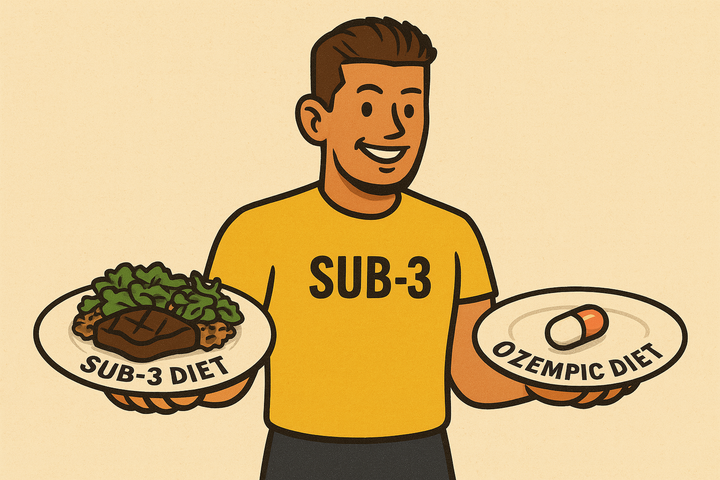
The main reason is weight control. Even with a low fat diet, it is easy to take in too many calories from sports drinks, bars and gels. If you are not careful, fuelling every run can lead to creeping weight gain. I have found that fasted easy runs help keep body fat low without too much effort or stress. The results show up clearly on the scales and in body composition data.
That matters, because in distance running, body composition directly affects performance. The less non-functional mass you carry, the more efficiently you can move. While you still need muscle to power your stride, excess body fat acts like dead weight. Even small reductions can translate to meaningful time gains over 42.2km.
But there may be deeper benefits too. Running with low circulating glucose, especially at a comfortable pace, can encourage the body to rely more on fat as fuel. Over time, this might improve what is known as metabolic flexibility: your ability to switch between fat and carbohydrate depending on the intensity and duration of effort. Some studies suggest that training in a low-glycogen state can increase fat oxidation, upregulate mitochondrial enzymes and improve endurance adaptations. These effects are modest, and not everyone agrees on their real-world significance, but they are real enough to be taken seriously.
Still, I am not chasing lab metrics. I care about results. Fasted easy runs help me stay lean, keep energy levels steady through the day and avoid unnecessary calorie intake. After these runs, I always have a 40g protein shake with skimmed milk to support recovery and gently replenish glycogen. Most days I will not eat again until dinner. My body is used to it and I feel fine.
What fasted running is not
I would never run a hard session without fuel. Interval workouts require carbohydrate if you want to hit your targets. Same with long runs. I always eat a bagel with peanut butter and jam two hours before, sometimes with half a VOOM bar too. During the run, I will refuel every 40 minutes or so with 2–3 gels. The goal is performance, not fat loss.
Fasted running is not about pushing through misery. It is not about ignoring warning signs or proving something. If you feel faint or dizzy, take a gel. There is no virtue in collapsing on the pavement.
The potential benefits
Beyond weight control, some studies suggest that fasted running can improve fat metabolism and help the body become more efficient at using different fuel sources. There is also emerging research into mitochondrial adaptation and metabolic flexibility. But even the strongest supporters usually advise using it sparingly, not as a blanket approach.
In my case, it is just part of the routine. It fits with how I train and how my body responds. And I know its limits.
Lessons from carb depletion
I have also experimented with more extreme strategies like carb depletion before race week. That is a separate approach with different goals. I would not recommend it for most runners and certainly not for first-time sub-3 attempts. But as with fasted training, it gave me a sense of control, especially around weight, reducing bloating and routine during the taper.
Five things to consider before fasted running
1. Know your goal
If you are already lean and not trying to manage weight, the main benefit of fasted running may not apply. You are unlikely to gain performance advantages from skipping fuel. Make sure you are clear on why you are doing it.
2. Start with easy runs only
Never go fasted into a hard interval session or race-pace long run. Performance suffers without carbohydrate. Keep fasted training for Zone 1–2 efforts where pace does not matter.
3. Adapt gradually
Fasted running takes conditioning. If you are new to it, start with short easy runs and always carry an emergency gel. Feeling lightheaded or faint is a sign to fuel, not something to push through.
4. Fuel recovery properly
Running fasted does not mean staying depleted. Always have protein and carbs soon after your session to support muscle repair and replenish glycogen. Under-recovering can lead to fatigue, illness or injury.
5. It is a tool, not a rule
Fasted running is optional. Many sub-3 runners never do it. Others swear by it. Like carb depletion or cold water immersion, it is a strategy you can experiment with, but only if it suits your body, your goals and your overall routine.
Finding this useful? Help keep Sub-3 running — support us with a coffee.