
Double London Marathon risks turning a great race into a running carnival
Splitting the race over two days may expand access and fundraising, but it risks weakening London’s standing as a serious race for the amateur elite.
The London Marathon has become a victim of its own success. Demand has surged to unprecedented levels, with more than 1.1 million people entering the ballot for 2026, and the event now sits at the centre of the global running calendar as both a mass-participation spectacle and one of the world’s largest one-day fundraising events. It’s already a record breaker. In 2025, it entered the Guinness Book of Records for largest number of finishers in a marathon.
Against that backdrop, a Guardian report this week revealed plans for a “Double London” format, which may see the race expanded across two days with up to 100,000 runners, a move apparently backed in principle by the mayor’s office and expected to generate tens of millions more for charity. On the surface, it is an ambitious and entirely understandable response to overwhelming demand, but it also raises questions about what the London Marathon is trying to be.
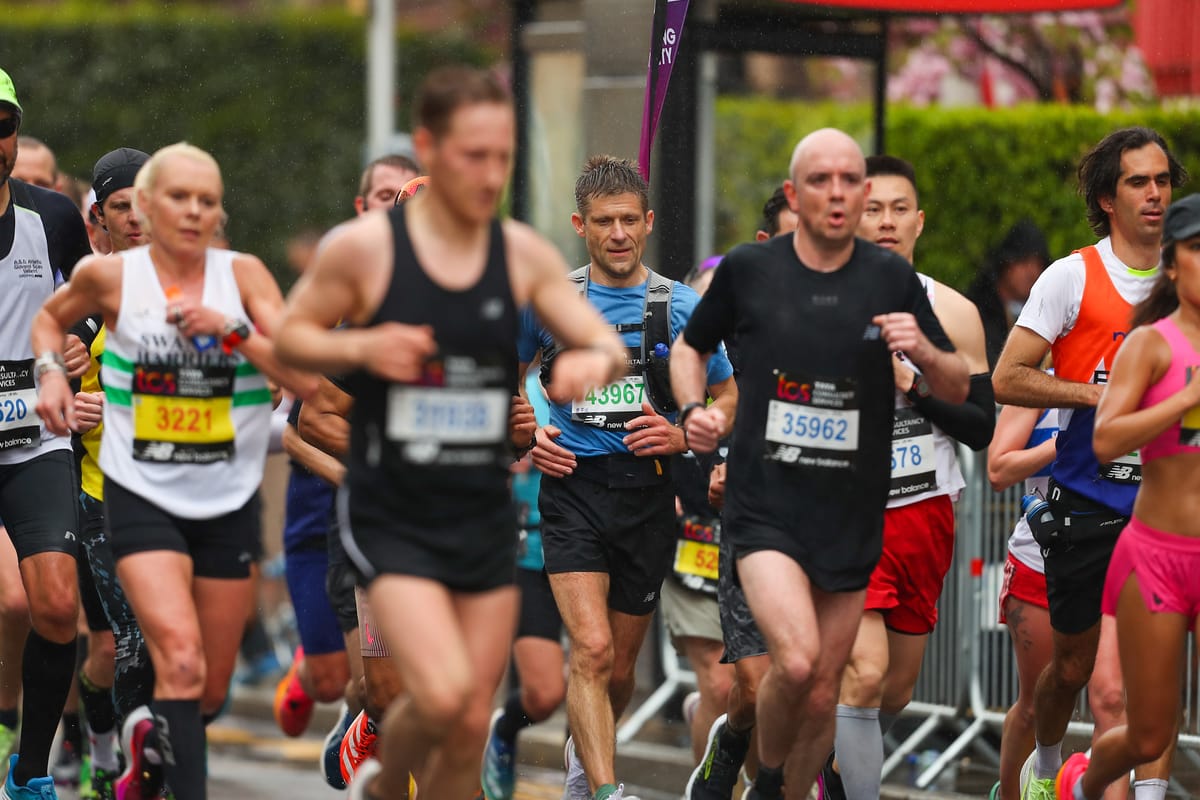
London has always occupied a delicate position between being a mass-participation spectacle and a genuinely competitive race for serious amateurs, and that balance is already under visible strain. Anyone who has run London in recent years will recognise the issue, as the early miles in particular are increasingly crowded - even in the Good for Age and Championship starts - forcing constant adjustments in pace and positioning, with runners drifting wide, clipping rhythm, and navigating through slower participants in a way that inevitably compromises performance. The congestion also makes it difficult to hold the racing line, meaning many runners are forced to “run long” rather than follow the shortest route, and it is not uncommon to hear reports of GPS distances coming in several hundred metres over the marathon distance once weaving and course deviation are taken into account. As a result, many sub-3 aspirants increasingly look to less congested courses, even if that means sacrificing spectacle and crowd support. A two-day format could, in theory, address some of this by reducing density and creating cleaner racing conditions, which would represent a sensible and proportionate evolution of the event.
However, that does not appear to be what is being proposed with Double London, at least based on the details reported by the Guardian, as the emphasis seems to be on accommodating more runners, increasing fundraising capacity, and expanding the overall scale of the event rather than materially reducing field density. Splitting the event into two days of 50,000 runners may ease pressure within each individual race, but if overall numbers continue to grow, it is not obvious that the underlying experience for runners will improve in a meaningful way. At the same time, London is already beginning to lose ground in one of the areas that has historically defined its status, which is its credibility as a race for the amateur elite.
According to the Sub-3 World Marathon Rankings 2026, London now sits only fifth in the UK by sub-3 percentage, even though more sub-3 performances take place there than at any other UK marathon. This contrast is telling, as it reflects the effect of scale, congestion, and mixed ability fields on overall racing conditions, and it reinforces a broader pattern in which smaller, more focused events offer a clearer path to fast times. Marathons such as Chester, Newport and Abingdon have leaned into that identity, prioritising flow, space, and race conditions in a way that London increasingly struggles to match.
There is also a less tangible but equally important issue, which is the character of the event itself. Part of what has always made London distinctive is its singular nature as a one-day race in which elites, club runners, and first-time participants share the same course and the same moment. Extending the event across an entire weekend is likely to dilute that unity to some degree and shift the emphasis away from a single, coherent race towards something closer to a broader participation event, and while that may align with the priorities outlined in the Guardian report, including greater inclusivity and higher charitable returns - which of course are highly laudable - it raises a fundamental question about what the London Marathon is intended to be in the years ahead.
Something clearly needed to change, as the current level of congestion is not sustainable, but simply increasing capacity without clear evidence that it will improve the racing experience may accelerate a shift that some runners are already beginning to notice. The direction of travel is becoming clearer, and unless organisers find a way to address it, the London Marathon is shifting away from its identity as a serious race for the amateur elite towards a large-scale running carnival that prioritises participation above all else.
Finding this useful? Help keep Sub-3 running — support us with a coffee.