Are sub-3 runners obsessed?
Sub-3 runners are often labelled obsessive, addicted or abnormal. But what if their dedication isn’t a problem to be solved, but a choice that reveals what humans can achieve?
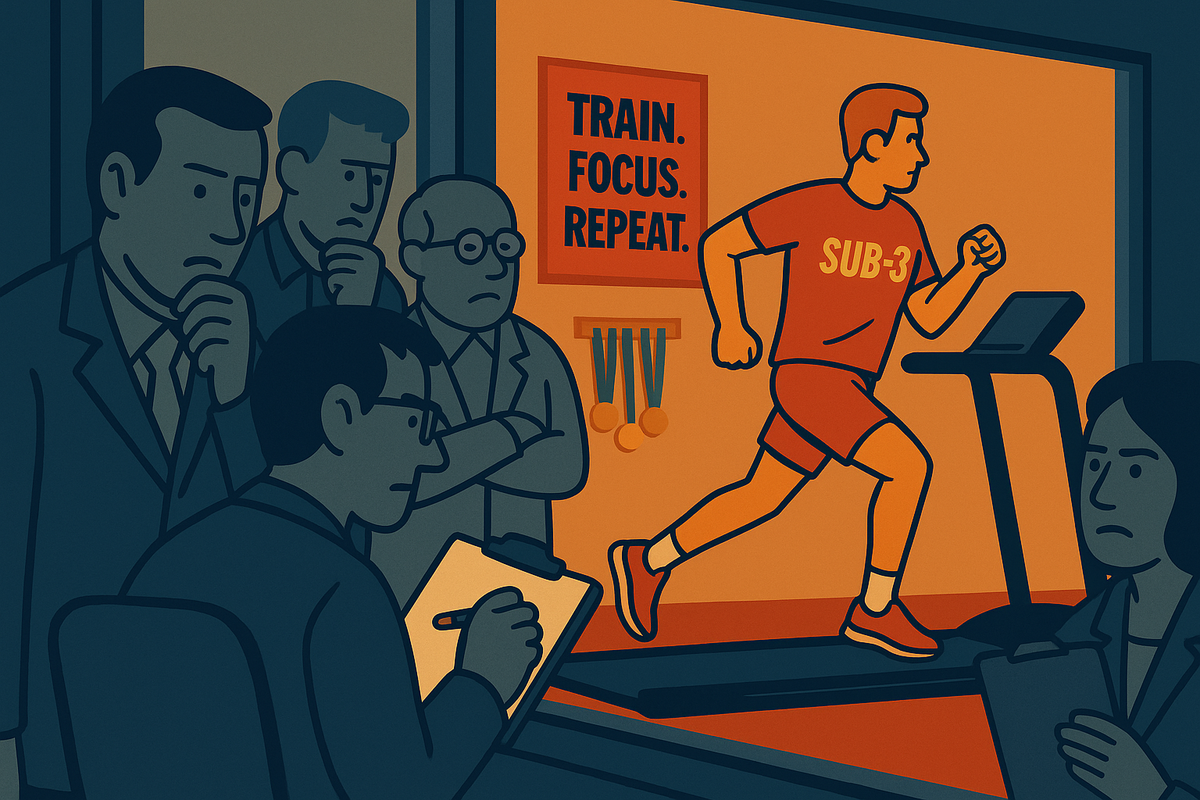
In The Lore of Running, Tim Noakes devotes four pages (pp. 548–551) to what he calls the “psychological addiction of running.” It’s a wide-ranging, non-judgemental summary of academic literature from the 1970s and 80s, but if today’s universities issue trigger warnings for potentially offensive material, this section might qualify for runners.
The academic language is revealing.
We hear from Sacks (1981), who writes:
“The running addict is characterised by a compulsive need to run at least once and sometimes twice per day… If prevented from running, such runners become irritable, restless, sleepless, and preoccupied with guilty thoughts that the body will decondition or deteriorate in some way.”
From Arnold Cooper:
“The marathon runner is likely to be quite far along the narcissistic-masochistic spectrum and, almost uniquely, carries on a useless activity that symbolises society’s need for a special hero… who enables the audience to share vicariously in some of his or her forbidden pleasures.”
Noakes reports that some researchers see running as particularly appealing to people with obsessive-compulsive tendencies. It provides a fixed long-term goal (like completing a marathon), legitimises repetitive daily routines (training), and encourages preoccupation with details (training methods, diet, shoes, even reading The Lore of Running).
Blumenthal et al. go further still, suggesting that some runners become addicted because they learn to use running to manage distress until they believe it's the only way to regulate their emotions.
So, are sub-3 runners obsessive-compulsive narcissists with addictive tendencies and masochistic egos?
No. We are driven, not disordered.
What these so-called diagnoses actually reveal is a deep suspicion among some academics toward discipline, repetition, and voluntary hardship. They reduce meaningful human endeavour to pathology. They struggle to understand why someone would voluntarily embrace discomfort, structure their life around a demanding pursuit, or choose to push beyond mediocrity. But that says far more about them than it does about runners.
This matters not because many people read obscure psychology journals, but because these ideas trickle down. They legitimise the tired pub logic that anyone could go sub-3 if they wanted, but “those people” are wired a bit strangely, addicted, joyless, maybe even running from something. They turn excellence into a quirk, a flaw, a punchline. And in doing so, they diminish the hard-earned achievement of going sub-3.
Yet much of what is described above could be said about any deep human passion: someone restoring antique furniture with obsessive care, composing music into the early hours, or building a research archive on medieval coins. Is that behaviour disordered, or simply what commitment looks like?
To commit to a big goal is not a failing. It is a feature of what makes humans great. As Matthew Syed argues in Bounce, elite performers across fields – sport, music, science – aren’t born different. They succeed because they practise obsessively. They put in the hours. The 10,000-hour rule may not be perfect, but it captures something essential: excellence takes time, effort, and yes, a degree of obsession.
Sub-3 runners aren’t addicted. We choose to run – to improve, to compete, to endure. And in doing so, we gain fitness, focus, and mental resilience. There are worse things to be obsessed with.
Finding this useful? Help keep Sub-3 running — support us with a coffee.