10 things we can learn from Emil Zatopek about going sub-3
Zatopek’s maximalism - his total commitment to training, effort, and experimentation - offers a blueprint for runners who want to discover how good they could truly be.
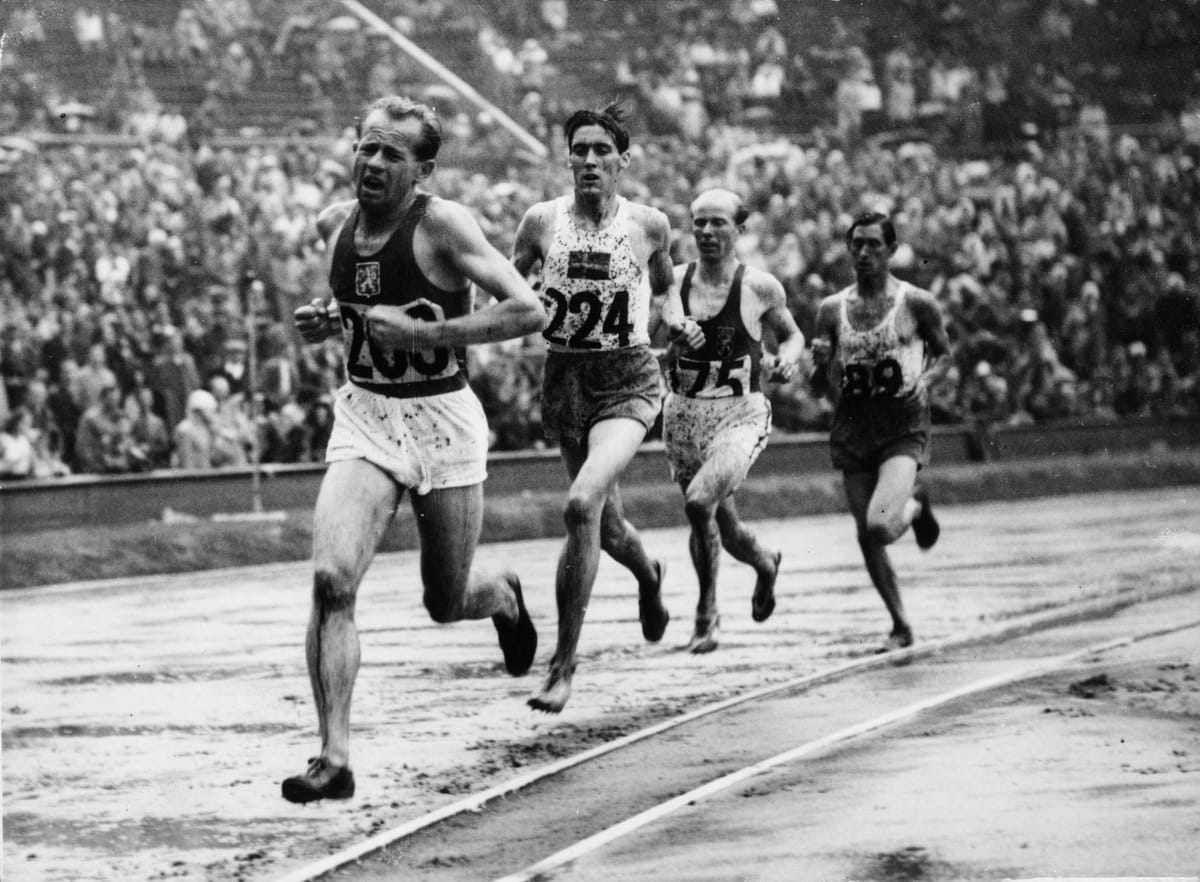
Without question, Emil Zatopek is one of the greatest athletes of all time - and for anyone aiming to go sub-3 (or beyond), there’s a huge amount to learn from him. A maximalist in the truest sense, Zatopek trained and raced with a ferocity, joy, and ingenuity that remains legendary.
Maximalism, in this context, means refusing to do the minimum. It’s about embracing full commitment: training with depth, living with discipline, and refusing to make excuses - no matter the conditions.
That said, we might start with a cautionary tale: Zatopek remains the only person in history to win Olympic gold in the marathon on his debut at the distance - and that was after already winning gold in the 5,000m and 10,000m earlier that same week at the 1952 Helsinki Games. A feat so extreme it’s unlikely (and probably unwise) to ever be repeated. Even Zatopek later acknowledged that the marathon should never be taken lightly. A few trial runs before attempting Olympic gold? Probably sensible.
But that aside, what follows is an attempt to distil ten powerful lessons from Zatopek’s life and training, drawn primarily from Richard Askwith’s superb biography, Today We Die a Little. For anyone serious about reaching their potential, there’s much to admire - and much to learn.
1. “When you can’t keep going, go faster.”
This captures Zatopek’s racing ethos. While others might crumble when overtaken in the final stretch, Zatopek would summon something deep inside of him, not just to survive the moment but to overcome it. That gear exists in all of us. The key is believing it’s there, and daring to use it.
2. Find a way to train - always.
Zatopek never made excuses. While serving in the army, he trained in heavy military boots and ran on sand. He carved running tracks into forest clearings. When confined indoors to do the laundry, he filled the bathtub with water and jogged barefoot in it for two hours. He didn’t wait for ideal conditions—he invented them.
3. Do interval training. And lots of it.
A true pioneer of interval training, Zatopek described his approach as “simple and primitive,” focused on “speed and stamina, speed and recovery,” with the golden rule: “Run fast and try to recover during the movement itself.” As Askwith explains, he took intervals to a new extreme: “turning them into tools for developing stamina and applying them in volumes that no one had contemplated before.”
4. Believe that your training will yield results.
“There was no one coaching him,” Askwith writes of Zatopek’s Olympic preparation, “just a solitary 25-year-old, hurling himself through the woods time after time, in the unwavering, almost religious conviction that the sacrifice must ultimately bring its reward.” That kind of belief can carry you through when nothing else will.
5. Appearance is irrelevant - performance is everything.
Zatopek wasn’t sleek or photogenic. As Askwith puts it, he ran “grimacing and writhing, eyes screwed up and tongue occasionally protruding.” Zatopek once said: “I am not talented enough to run and smile at the same time.” That honesty endeared him to the public. He looked like a man in the trenches—not a billboard. “He runs like us.”
6. Racing is part of training.
In 1949, Zatopek ran 22 track races from May to September across eight countries, in distances from 1,500m to 10,000m. He won all but one. “He loved to race,” Askwith writes, “to pit himself against the strongest opposition he could find and see who was best.” Racing wasn’t just a performance - it was practice.
7. Kindness is compatible with greatness.
Zatopek had a “zest for human interaction,” Askwith notes. He chatted with competitors before, after, and even during races - often in fragments of languages he barely knew. His joie de vivre “brightened the process for all concerned.” He also shared his training methods openly. There was no mystique. Just joy, generosity, and hard work.
8. It wasn’t genetics - it was work.
Zatopek was, in Askwith’s words, “a rather average physical specimen.” His strengths - economy of movement below the waist and extraordinary recovery - were earned through training. “Simply that, for five years now, he had been training harder, longer, and more ferociously than anyone had ever trained before.”
9. Tactics are overrated.
“I am not particularly interested in beating my opponents,” Zatopek said. “Above all I am interested in improving on my own performance. Why should I profit from my opponents’ weaknesses?” He didn’t play games. He ran to capacity and let the results speak for themselves. It wasn’t clever - but it was clean. And it worked.
10. Innovate, always.
Zatopek was considered “uncoachable,” but not because he was arrogant - because he was relentlessly experimental. He adapted to winter cold, to army restrictions, to boredom. He invented sessions and systems to keep moving. “He would never let himself get bored,” Askwith writes. “In spirit, more boy than man.”
In praise of Zatopek’s maximalism
There will likely only ever be one Emil Zatopek. But for those of us chasing our own limits - whether that’s sub-3, sub-2:40, or simply a personal best - there’s much to take from his approach.
No, you don’t have to fill your bathtub with laundry and run in it. But you can channel the spirit. The refusal to make excuses. The joy in effort. The belief that something extraordinary waits on the other side of total commitment.
Zatopek didn’t dabble in greatness. He lived it. And we don’t need to copy his training to follow his example. We just need to train with purpose, race with courage - and never stop asking how far we might go if we gave it everything.
Finding this useful? Help keep Sub-3 running — support us with a coffee.